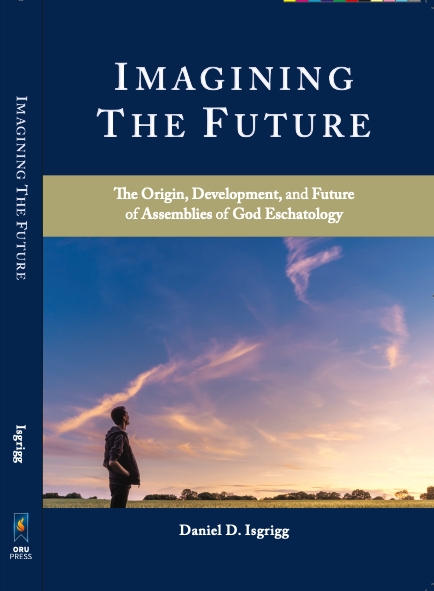
During my doctoral research about the history of Assemblies of God beliefs about eschatology, I made several interesting discoveries. While most know Pentecostals have historically followed premillennial, dispensational, and pretribulational forms of eschatology, I have to admit that many of my assumptions about those beliefs were challenged and/or corrected by what I found articulated in AG magazines, books, and doctrinal statements. I documented these revelations and a history of the development of these doctrines in my book, Imagining the Future: The Origin Development and Future of Assemblies of God Eschatology.
Here are 5 surprising facts about AG end time beliefs that that I discovered that definitely caught my attention and I would imagine are a surprise to even the most seasoned AG minister.
1. The Statement of Fundamental Truths does not have a position on the tribulation. While pretibulationism is very popular in the AG, and four of the sixteen doctrinal statements articulate common end-time beliefs (blessed hope, millennium, final judgment, and new heavens and earth), the tribulation has actually never been part of any of the official doctrinal statements. (See chapter 3)
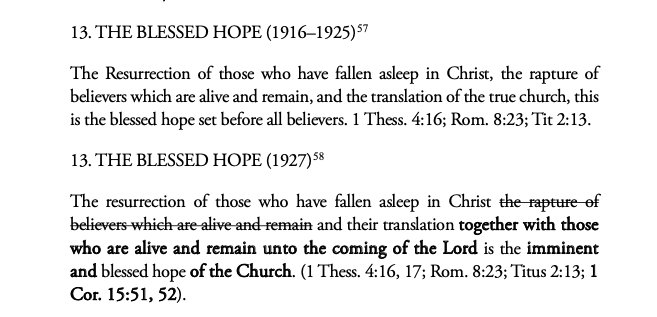
2. The term “rapture” was removed from the SFT in 1927. Most people in the AG associate the return of Christ with the “rapture.” But interestingly, though the blessed hope doctrine contained the term “rapture” in 1916, the crafters of the 1927 revision to the SFT intentionally removed the term and it has remained absent from the wording in Blessed Hope until today. (See chapter 3)
3. The Scofield Reference Bible was outlawed in 1924 by the AG Executive Presbytery because of its fundamentalist teachings. As popular as the Bible was in Pentecostal circles for its teaching about eschatology, AG leaders deemed Scofield’s teachings on the Holy Spirit out of harmony with Pentecostal belief, including his dispensational teachings and stopped promoting and selling the Bible. However, after some reconsideration, the AG re-instated it and even sold it with the caveat that it must be accompanied by a pamphlet with a list of disagreements with his doctrine. (See chapter 4)
4. Three of the most important early AG leaders held tribulational views other than a pre-trib position. In 1919, the first general superintendent, E.N. Bell, told Pentecostal Evangel readers that he favored the mid-tribulational view. J. R. Flower also discussed the debate around the various views and admitted he leaned toward mid-trib, but ultimately concluded, “There is so much room for speculation here that it behooves none of us to be dogmatic.” Even more surprising is that D. W. Kerr, one of the primary architects of the SFT, held there were three raptures: pre-trib, mid-trib and post trib! (See chapter 6).
5. In 1988, the AG did not publish a single article on eschatology in the Pentecostal Evangel. This was remarkable considering the amount of end-times speculation in evangelical circles concerning the popular “88 Reasons Christ will return in 1988” teachings brought about by books by Edger Whisenant and Hal Lindsey. The same was true of 1999 when Y2K computer doomsday speculation was at its height. Yet in both cases, the AG did not participate at all in such speculation and articles even condemned prophecy teachers for their “foolish” and “embarrassing” speculative teachings on these things. (See chapter 10)
Many people in the AG assume that the beliefs have been fairly uniform and follow most popular teachings on the rapture and premillennial eschatology. But these five facts alone show a few of the surprising and interesting nuances to the AG’s expressions that have taken place over the past 100 years. If you are interested in reading more, check out my 2021 book from ORU Press. https://www.amazon.com/Imagining-Future-Development-Assemblies-Eschatology/dp/1950971082/
 Daniel D. Isgrigg
Hi Daniel, I appreciate your post and agree with you that the AoG 16 Fundamental Truths take no position on the Tribulation. But to add balance, the AoG position paper “The Rapture of the Church” does explicitly support the position of the pretribulation rapture.
Pingback: Interesting Facts about the AG’s Statement of Fundamental Truths | Daniel D. Isgrigg