In this blog, I want to share some advice for those considering a Doctor of Ministry (D.Min.) degree. I have taught in the D.Min. program at Oral Roberts University for several years. During this time I gained some valuable insights into the purpose of the degree and the keys to success for students. If you are considering a D.Min Degree, there are a couple things to know before you begin.

Know the Difference Between a D.Min. and a Ph.D.
For theological doctoral degrees, there are two options: D.Min and Ph.D. But these are very different degrees.
A Doctor of Ministry (DMin) is a professional doctorate degree designed to develop expert practitioners of ministry. The content of the classes help develop deeper understandings of ministerial practices, personal development, and leadership competencies. As an “Applied Research” degree, D.Min. Students draw from scholarly knowledge in their field of ministry in order to apply that knowledge to a particular ministry context through a ministry project that addresses a local ministry issue. So they do not produce theological dissertations, they do research to develop a project that will improve ministry practices.
A Doctor of Philosophy (PhD) is an academic research degree designed to create new knowledge or theories in a field of study or discipline. Students conduct original research on concepts or topics in theology that have not been researched, rather than describing what is already known. The goal of the Ph.D. is theological expertise and production of scholarship. If that is your goal, see this blog.
So there is a difference between the two degrees, both in the focus of the curriculum and the desired outcome. The skills gained in a D.Min. Program are to be applied to local ministry contexts. The skills learned in the Ph.D. program are to be applied academic contexts such as Bible Colleges and Universities, though there are often some faculty with D.Min. degrees.
The Goals of a Doctor of Ministry
If your goal is to help the local church do ministry better, I recommend doing a D.Min., rather than a Ph.D. This degree helps ministers develop higher levels of expertise in specific areas of ministry. Here are some of the goals of D.Min. degrees.
- Gain deeper knowledge of particular ministry practices such as preaching, evangelism, pastoral care, spiritual formation, discipleship, and leadership.
- Solve ministry problems at the local ministry level by researching the best theories and practices.
- Contribute to the church’s understanding of ministry by implementing ministry research into local contexts.
The Doctor of Ministry assumes one already has some level training, education and experience in that area of ministry. So a pastor can become a better pastor. A chaplain can become a better chaplain. But D.Min is not really designed to train to someone to be a different kind of minister.
What the D.Min does best is help minsters focus on new areas that they may want to develop. For example:
- A pastor that wants to increase participation of the congregation in a new area of ministry.
- A ministry leader that wants to develop new areas of focus within the ministry.
- A staff pastor who wants to develop new curriculum for training leaders.
- An evangelist that wants to develop new methods of evangelism.
- A counselor or chaplain that wants to learn more about new techniques for helping clients in areas such as treating moral injury.
That is why this degree is perfect for those who are currently in ministry and want to research ways to understand and improve their current ministry competencies.
Elements of a Doctor of Ministry Program
Because of these goals, most D.Min. programs feature the following elements.
Coursework – Most D.Min. degrees have 2-3 years of classes that focus on ministerial development, leadership competencies, and theological reflection. Since every persons ministry context and project is different, the courses focus more on helping the student reflect on the areas based on their specific ministry. In this way, it is much different than an M.Div. program where you might take classes specific areas, such as evangelism. Instead the D.Min. classes help students process thier ministry through lenses like leadership theory, theological foundations, and personal formation.
Research – Assignments within the coursework are designed to facilitate deeper research on ministry. These are opportunities for students to explore new theories, practices and theologies of the area of interest in ministry. By utilizing scholarly research, the student gains greater knowledge and expertise they can use in their ministry project to apply to their specific ministry context.
Project Implementation – Following the coursework, students then work on their ministry project that demonstrates their ability to apply their research into local ministry contexts. This process is usually 1-3 years. Instead of writing a theological or doctrinal treatise, D.Min. students execute a project in their ministry context to improve the way in which they do ministry. This is very similar to other applied research degrees such at the Ed.D, the D.Miss, and other practical and professional doctorates.
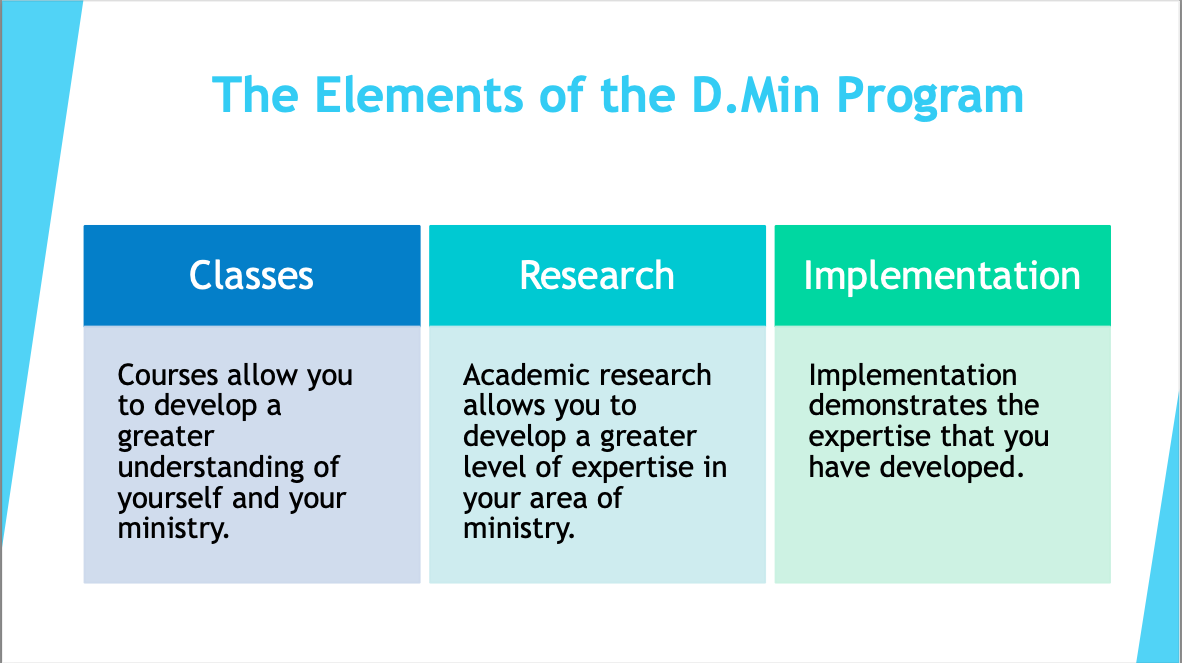
Together these elements help build competencies that propel ministers into greater areas of ministry. They truly become a Doctor of the Church.
Advice Before you Start a D.Min. Program
Having taught in the D.Min. program for several years and now leading ORU’s program, here are a couple of things one should consider before starting a D.Min. program.
Are you called? – All higher education is a calling. If you have a sense of calling, it will sustain you through the difficult seasons during this 3-5 year journey. As busy ministers, there will always be tough moments when you will question if you should finish. That sense of calling will help you through.
Do you have a ministry context? – The D.Min. assumes you are already involved in a ministry that you can research. If you are new to ministry, I suggest doing an M.Div first and finding a place of ministry before doing a D.Min. But if you are already serving in ministry and have a masters, that makes for the best experience for students in the degree. In fact, some schools even require both an M.Div. and several years of experience in their ministry context to ensure ministers can successfully complete the ministry project.
Are you prepared to write extensively? The DMin is a writing degree. In addition to doctoral level research papers and assignments, the student will write a 200-300 page ministry project as the capstone of the degree. Students are not only expected to write extensively, but also exhibit a high level of academic writing skills reflective of a terminal degree. If you don’t enjoy writing, this is probably not the degree for you.
Are you committed to learning and growing? The most successful students are those that have a commitment to learning new ways of thinking about their ministry. For most students that is not a problem because they love learning and benefit greatly from the personal formation that comes from studying. But there can also be a temptation to see doctoral work as a way to validate the knowledge ministers already have about ministry. But be careful that this is not your goal. Doctoral research should help the minister think about their ministry in new and deeper ways. This process is not easy, but it is necessary. (See my article on this process of intellectual conversion).
Do you have time, energy, and resources to commit to this? Most programs are “full time” and expect students to spend up to 20 hrs per week per class in reading and assignments, especially in online and modular format programs. If you are a busy pastor or minister, make sure you have a plan to make room for this reality. Also make sure you go in with a very realistic understanding of the cost, not only of tuition, but also of travel and residency obligations. Its good to be fully aware of what you are committing to for the next 3-5 years.
What is your motivation? The final advice is to check your motivation. Students join the D.Min. program for various reasons. The most successful students are those who are active in ministry but have a desire to do ministry better and solve real problems at the local level. Other goals such as new credentials or to get a job are understandable, but often those motivations fail to sustain the student through the rigors of the program. The best reasons to do the degree are to grow and expand your expertise in ministry to make a bigger impact on the kingdom of God.
Conclusion
The Doctor of Ministry degree is a wonderful degree that can enhance the ministry of pastors, leaders, evangelists, lay ministers, and professional counselors or chaplains. I have worked with some really wonderful ministers who are deeply committed to the local church and the impact they can make on the kingdom of God. If you are considering a D.Min. Program, I hope this information will help you know if this degree is the right one for you. I encourage you to pray hard, create space in your life, and be ready for the journey of growing deeper as a minister.
If you are looking for a Spirit-empowered D.Min. Program to develop your ministry and leadership, I hope you will check out ORU’s Doctor of Ministry Degree. https://oru.edu/academics/cotm/graduate/doctor-of-ministry.php. ORU has two concentrations. The Church Ministries and Leadership Concentration is designed for ministers of all varieties who want to hone their ministry skills. The Pastoral Care and Chaplaincy concentration is designed for counselors, chaplains and other ministers in that field. This degree has a specialization in the new field of Moral Injury.
If you want more information, you can contact the Office of Graduate Admissions
Phone: 918.495.6518
gradadmissions@oru.edu.
***Disclaimer. This is my personal blog and is not the blog of Oral Roberts University. The opinions expressed on this and other blogs posts are my own and do not necessarily reflect the opinions of the university.***
 Daniel D. Isgrigg
Pingback: Practical Advice Before you Pursue a Doctor of Ministry Degree | Pentecostal Theology
Pingback: Doctor, Professor, or Scholar: Clarifying the Difference in Academic Titles | Daniel D. Isgrigg