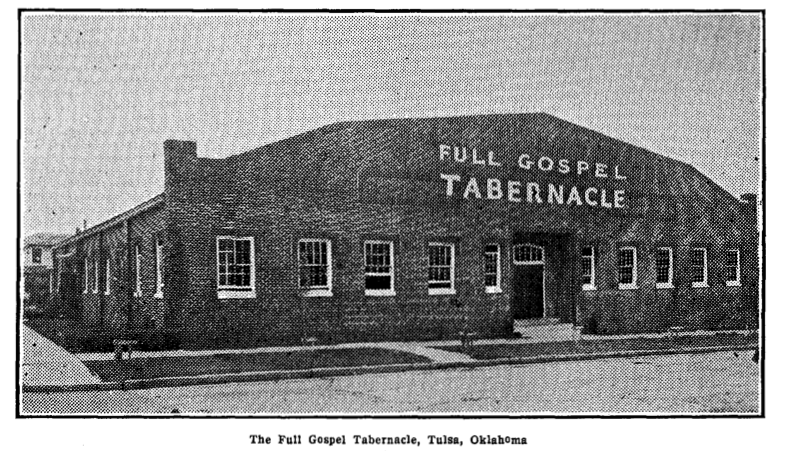
The first Pentecostal church in Tulsa traces its origins to Vandella Frye, reportedly the first Pentecostal in Tulsa in 1905. Frye faithfully spread the Pentecostal message through prayer meetings in her home until an Apostolic Faith Mission was formed in 1908. That mission eventually became known as 5th and Peoria/Full Gospel Tabernacle, and later Central Assembly of God. It was an important church that eventually helped form Assemblies of God in 1914 . But it can all be traced back to Sister Vandella.
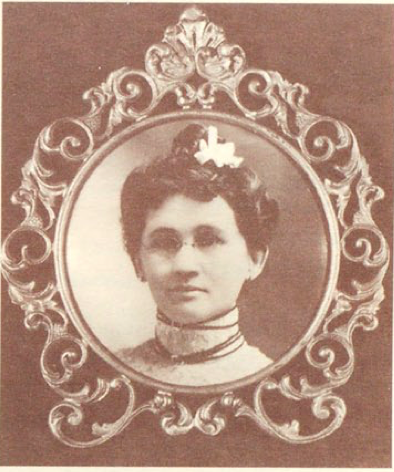
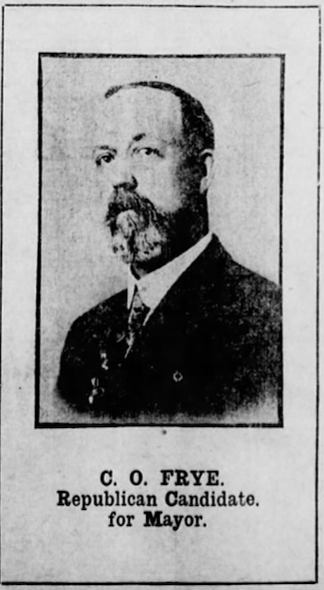
Vandella Frye (or Vandalia Fry as some accounts have her) was the first Pentecostal in Tulsa. Living near Galena, Kansas in 1901, Frye heard Charles Parham speak about Pentecost and she received the baptism in the Holy Spirit. In 1905, she and her husband C. O. moved to Tulsa to start a concrete business in Tulsa’s booming economy after oil was discovered.[3] Unlike many early Pentecostals who were poor, the Fryes seem to have been well to do. In 1912, Frye’s husband, Charles, a successful business leader in the community, ran for Mayor.[16]
Vandella Frye testifies that when they arrived in 1905, she was the only person in Tulsa to have received the Pentecostal experience.[4] To share the message of the baptism in the Spirit, she held cottage prayer meetings in her home for those interested. Gerald Pope described her as follows. “Soft spoken, yet had a strong personality. Her leadership ability and personal magnetism enabled her to hold things together when a new spiritual venture was in a formative or critical stage. She dressed well, though not extravagantly, and her silvery hair gave a striking appearance.”
In the first few months, three people received Pentecost in her home. But Frye didn’t feel called to preach and knew she needed to send for Charles Parham to come preach the Apostolic Faith message. To finance Parham’s campaign in Tulsa, she sold her diamond ring for $1,500 to secure Parham’s band and invest in a tent for the two month revival .[5]

In a tent set up at 4th and Elgin, over a hundred people came to Christ, and twelve received the baptism in the Holy Spirit at the altar services. A few weeks later, the tent was moved to a lot at 2nd and Cincinnatti.
Some of the converts became the core group for what would eventually form an Apostolic Faith Mission. These included: Fannie Hughes, Mabel Hughes, Willa Lowther (missionary to China), Mr. and Mrs. A. J. Welker, Martha Baxter, E. K. Gray, Oscar Wolfe, Frank Carter, Mr. and Mrs. John Reddout, and Mrs. Sam Dague. A year later, Parham’s sister-in-law, Lillian Thistlewaite, ministered in the city. One of her with notable converts was Willard Pope, founder of the first Pentecostal church in Broken Arrow. Parham returned to Tulsa in September and again in November to continue the great work.
Not long after Parham’s campaigns, Frye leased a small former Methodist Episcopal Church building at 2nd and Cincinnati to hold meetings three times a week. But she did not assume the preaching duties.[6] Instead, Frye reports, “People wonder how we have such meetings without a preacher, but when they come out, they see that we have many preacher[s], and the best of all we have the power of the Holy Spirit in all our meetings.”[7]
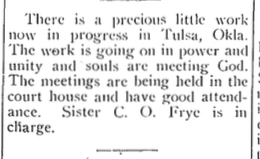
In September of 1908, Mrs. J. C. Ament attended one of the meetings where she was healed of blindness, spinal trouble, and gastritis. She proclaimed, “Oh such rest and peace! Such joy! Such heavenly divine sweetness filled my soul. Rivers of living water flowed through me. Volume after volume of love and power seemed to take full possession of body soul and spirit. … I am praising Him continually for the real evidence of this Pentecostal baptism, not only speaking and singing in tongues, but for enduement of power to glorify Jesus and witness for Him.”[9]
As attendance grew, the church looked for a permanent home. For a short time in 1909, they rented the old Indian Territory Courthouse next door on 2nd Street between Cincinnati and Detroit.[10]


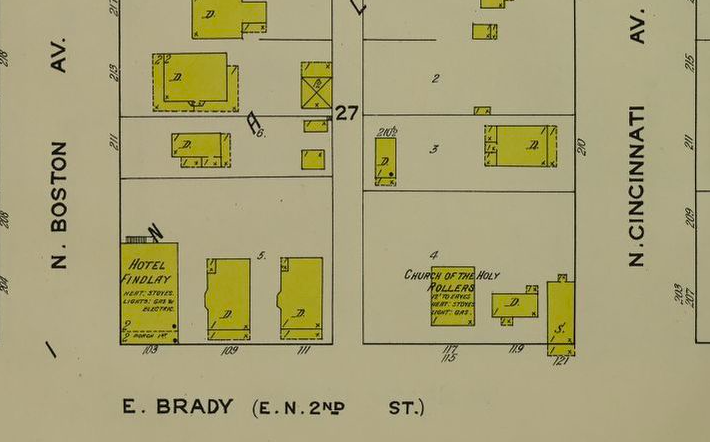
Finally, the Apostolic Faith Mission leased a lot on the corner of Brady and Cincinnati, at 115 E. 2nd Street/Brady, the current site of the Guthrie Green. They built a small frame 20″ x 40″ building where they would hold their meetings. The city officials nicknamed it the “Church of the Holy Rollers.”
Over the next few years, Frye invited Pentecostal preachers to hold meetings to further the Apostolic Faith message. In 1909, A. S. Copley, editor of The Pentecost, had glowing reports of his ministry in the city and described the saints as “happy, earnest and aggressive, yet so free from fleshly noise and energy.”[11] In 1909, W. M. Allison led the church and frequently held tent revivals around the city. In the Spring of 1911, L. P. Adams, a white minister within C. H. Mason’s Church of God in Christ, held revival services in Tulsa.[12] Charles Squire and his wife, Sarah, of Danville, Illinois, also came to the city in October of that same year. The Squires were evangelists and songwriters who put out an early Pentecostal songbook called Psalms, Hymns, and Spiritual Songs with Shelley E. Kinnee.[13] Williard Pope, the young minister who pioneered the Assembly at Broken Arrow, stepped in to lead after Adams in 1911.
In 1912, W. T. Gaston was invited to Tulsa to take over the work. Gaston and Jim “Daddy” Reeder led the church to relocate to the suburbs at 6th and Peoria in 1912 and the church grew and thrived. Gaston become the leader of the Oklahoma District when the Assemblies of God formed in 1914 and 6th and Peoria became a prominent church in the movement. He was followed by early AG leaders S. A. Jamieson, Harry E. Bowley, and Jonathan E. Perkins. Gaston eventually became General Superintendant of the AG in 1925.
Although she resisted being called the pastor, Vandella Frye should be rightfully recognized as the founder of Pentecostalism in Tulsa and a pioneer for Pentecostalism in Oklahoma. She not only brought Pentecost to Tulsa, but she shepherded the Pentecostal believers in the early years. Through her faithful witness and sacrifice in pioneering this original mission, several other Pentecostal works were established and Pentecostalism took deep root in Tulsa.
The archive for Central Assembly is housed in the Holy Spirit Resource Center of the Center for Spirit-empowered Research at Oral Roberts University in Tulsa. It has a large number of artifacts and historical materials that are preserved for future generations. There are also many materials at the Flower Pentecostal Heritage Center in Springfield, Missouri.
For more on Tulsa’s Pentecostal History, you can check out my book, Pentecost in Tulsa.
[1] “The Big Tent Meeting,” The Morning Tulsa Daily World, June 8, 1906, 1.
[2] Sarah Parham, The Life of Charles F. Parham: Founder of the Apostolic Faith Movement (Joplin, MO: The Tri-State Printing, 1930),206. However, the date August 1908 is quoted from Mrs. C. O. Frye, rather than Sarah Parham. So it is possible that the 1908 date was wrong all along.
[3] It is interesting that most of the later accounts for Tulsa’s Central Assembly (5th and Peoria) have the name “Vandalia Fry.” However, her own testimonies sent to Pentecostal papers has her last name as “Mrs. C. O. Frye” and Ancestry.com records have her name as “Vandella M. A. Burke,” married to “Charles O. Frye.”
[4] “Tulsa, Oklahoma,” The Latter Rain, 1908, Pauline Parham Collection, Oral Roberts University.
[5] “Journey Through Time,”Central Assembly of God, Tulsa Oklahoma, 1997; Clarence B. Douglas, The History of Tulsa, Oklahoma: A City with Personality (Chicago: J. Clarke Publishing, 1921), 293, notes that it was 1908 that Parham came to Tulsa. This is disputed by the June 1906 Tulsa World report and the 60th Anniversary Celebration, Central Assembly of God Church, 1968, Flower Pentecostal Heritage Center. It is also possible that Parham could have returned in 1908. This is doubtful, however, because Parham had fallen out of favor in many Pentecostal circles by 1908.
[6] Frye’s husband, C. O. Frye, owned a concrete business, the Tulsa Cement Stone Co., and was instrumental in building some of Tulsa’s most famous buildings. Some accounts say she sold the ring to secure a tent for Parham to come. However, it is more likely that the money would have been needed to secure the building, rather than a tent.
[7] “Tulsa, Oklahoma,” The Latter Rain, 1908, Pauline Parham Collection, Holy Spirit Research Center, Oral Roberts University, Tulsa, Oklahoma.
[8] Mrs. J. C. Ament, “Atrophied Optic Nerve, Spinal Trouble, and Gastritis Healed,” Latter Rain Evangel, February 1909, 19-20.
[9] ibid., 20.
[10] The Pentecost, November 1, 1909, 4; History of Tulsa, 293.
[11] A. S. Copley, “Victory in Tulsa,” The Pentecost, April 1909, 5.
[12] “Revivalist Returns Home,” The Morning Tulsa Daily World, May 2, 1911, 8.
[13] “Pentecostal Song Book,” Bridegroom’s Messenger, November 15, 1910, 2.
[14] “Tulsa, Oklahoma,” The Bridegroom’s Messenger, November 15, 1911, 2. See Word and Witness, December 20, 1913, 6. Squire died of leukemia on January 14, 1916, but Sarah Squire continued to minister and became an instructor at T. K. Leonard’s Gospel School in Findlay, Ohio. See, “Elder Chas A. Squire Called Home,” Bridegroom’s Messenger, March 1, 1916, 2.
[15] “Have Good Dinner: County Prisoners Eat Well and Hear the Word Preached,” The Morning Tulsa Daily World, December 28, 1910, 1.
[16] “Political Announcements,” The Morning Tulsa Daily World, January 23, 1912, 4. This is not to be confused with the C. O. Frye from Chickasha, Oklahoma who was a noted lawyer during the same era.
[17] “C. O. Frye and What He Stands For,” The Morning Tulsa Daily World, March 19, 1912, 3.
 Daniel D. Isgrigg
Thanks, Danny, good research! Galena caught my eye. Essentially still a back country rural town, roughly half an hour south of Springfield, it’s almost hard to imagine a well to do contractor from there, but perhaps he did well in Tulsa in the boom.
Would I be correct that Parham had his start in the Kansas outpouring in 1900?
I attended the 5th and Peoria Central Assembly for a time during my years at ORU. Fun history.
Pingback: 2024 in Review | Daniel D. Isgrigg