In 2023, I was invited to contribute a chapter on Pentecostal and Charismatic Christianity in the North America volume of the Edinburgh Companions to Global Christianity. I am grateful to Kenneth Ross, Grace Ji-Sun Kim, and Todd Johnson for allowing me to represent Spirit-empowered Christianity in North America for this beautiful and informative volume. This series of Companions on Global Christianity offers insights by a diverse set of scholars who pinned the regional essays, profiles of major theological communities, and essays on key themes in North America.
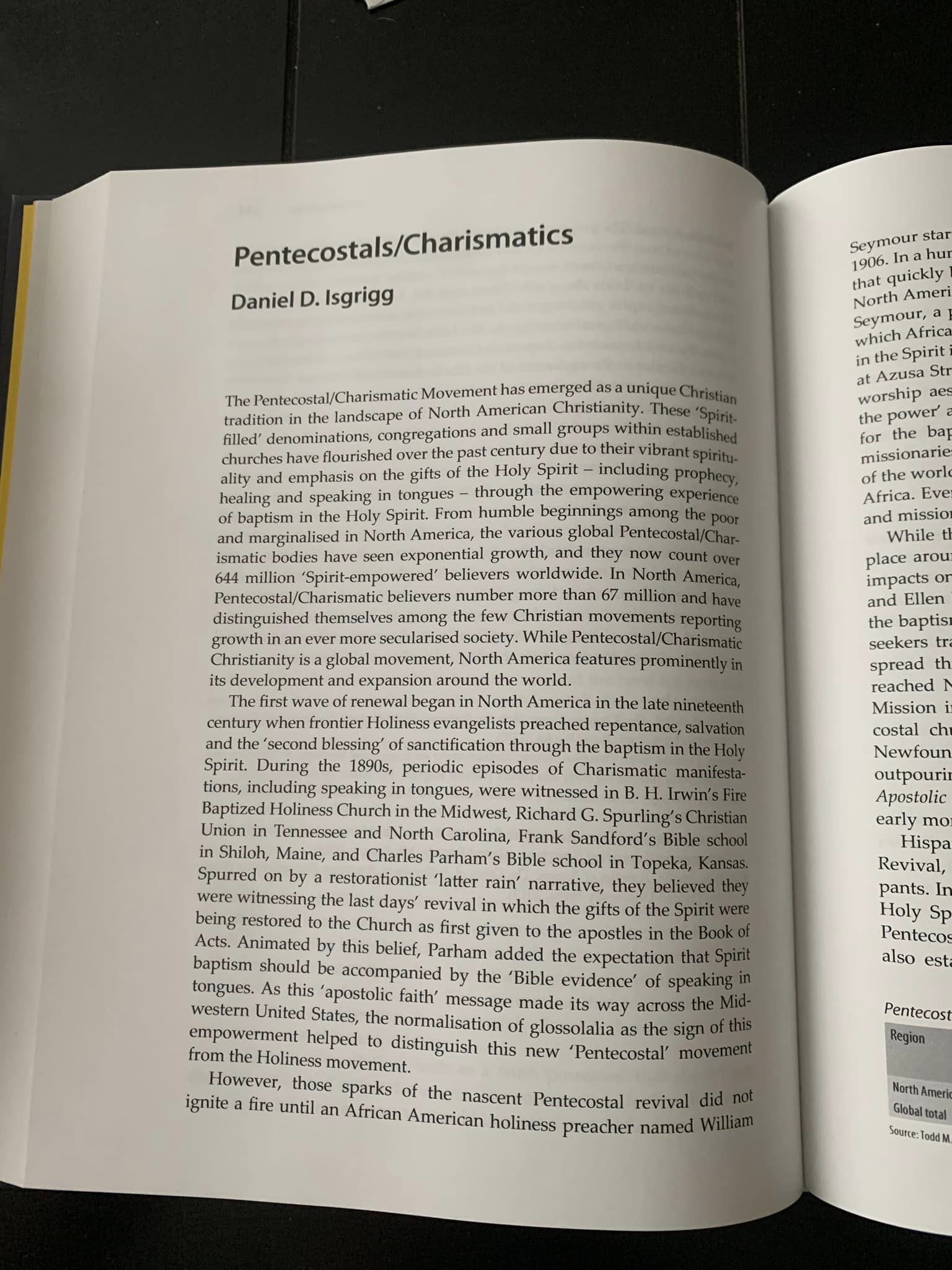
While I can’t share the full text because of copyright restrictions, I wanted to offer a few bits of reflection from that essay on North American Spirit-empowered Christianity. As this is an academic reference book, many individuals may never get a chance to read it. I believe sharing these few insights will be helpful to those interested in the ethos of Spirit-empowered Christianity in North America.
In the opening, I begin by pointing out that the Pentecostal-Charismatic Movement sees itself as a unique Christian tradition in the landscape of North American Christianity. I note, “These ‘Spirit-empowered’ denominations, congregations, and small groups within established churches have flourished over the past century due to their vibrant spirituality and emphasis on the gifts of the Holy Spirit – including prophecy, healing and speaking in tongues – through the empowering experience of baptism in the Holy Spirit. From humble beginnings among the poor and marginalized in North America, the various global Pentecostal-Charismatic bodies have seen exponential growth, now numbering over 644 million ‘Spirit-empowered’ believers worldwide. In North America, Pentecostal-Charismatic believers number more than 67 million and have distinguished themselves among the few Christian movements reporting growth in an ever more secularized society. While Pentecostal-Charismatic Christianity is a global movement, North America features prominently in its development and expansion around the world.”
To begin my analysis of the unique features of North American Pentecostal and Charismatic communities, I note that this region is experiencing growth, but not at the same level as globally. “While the global communities are being noted for expanding rapidly, North American Pentecostal denominations are mostly stagnate or in decline. The major exception to this is the ethnic and immigrant populations within these communities that are fueling overall growth. Overall, Pentecostals and Charismatics in the United States have increased from 13.8 million in 1970 to 65 million in 2020 but have failed to keep up with population growth. While Pentecostals and Charismatics increased by 14 million from 2000 to 2020, their total percentage of all Christians declined from 12.1% to 10.5%. In Canada, Pentecostals and Charismatics more than tripled, from 709,000 in 1970 to 2.3 million in 2000. But growth has stagnated since, reaching 2.75 million in 2020.”
Then I turn to the primary reasons for the growth of Pentecostal and Charismatic Christianity. First, above all else, is experiential theology that SE Christianity offers. I note, “Pentecostals draw the pattern of these experiences from the Bible, primarily from Luke-Acts, to argue that the baptism in the Holy Spirit accompanied by speaking in tongues, healing and spiritual gifts is normative for the Christian life. The supernatural orientation allows for improvisation and openness for miracles to break into the everyday spiritual, psychological and physical needs of people. Pentecostal and Charismatic worship is participatory, characterized by exuberant expressions of praise, dance, testimony, prayer, laying on of hands for healing and exercise of spiritual gifts. Charismatics in particular place an emphasis on community participation in exercise of the charismata, as opposed to Classical Pentecostals who tend to focus on speaking in tongues as the distinctive characteristic.”
But it is more than just spirituality, much of the rise in growth is due to Pentecostal and Charismatic immigrants coming to the U.S. in the past few decades. I note, “Many of these immigrant groups brought their indigenous Pentecostal or Charismatic faith with them and established diaspora churches to provide social support and cultural spirituality that helps immigrants navigate the social and economic challenges of living in North America.” Indeed growth from the Global South through immigration has created very strong Hispanic Pentecostal communities. “Spirit-filled Hispanic churches make up the largest portion of Spanish-speaking Protestants in the US and Canada. Latin Pentecostals tend to be more socially engaged than North American churches and use the Pentecostal message to proclaim liberty and social change in their communities.” This is also true of African Pentecostal immigrants to the U.S. who “establish diaspora churches with the ‘reverse mission’ of re-evangelizing North America. In addition to new diaspora churches being planted, many immigrant churches are founded or supported by transnational megachurches and Charismatic networks from the continents of Asia and Africa. Exhibiting a higher emphasis on Pentecostal spirituality, healing, deliverance and the prophetic gifts than North American denominations, transnational church networks have expanded into North America with great success.”
Another strength of Spirit-empowered Christianity is the inclusive and egalitarian ecclesiology that challenges the status quo of social roles, particularly in leadership for women. I note, “These churches recognize the Holy Spirit’s ability to call anyone to serve as pastors, evangelists, missionaries, rescue home workers, and educators. Yet, the legacy of empowerment of women in this tradition is somewhat paradoxical. Though openly supporting women in ministry, some Pentecostal denominations hold strong complementarian convictions that restrict women from lead pastoral roles and denominational leadership. In these spaces, many women have created alternative leadership avenues, such as church mothers and women’s ministries, where influence over the church is less formal yet is strongly felt. Also in these contexts, women face modesty standards as well as attitudes about traditional gender roles that restrict the free agency of women. However, this is less so in independent Charismatic churches where women themselves are leaders of large ministries and many husband-and-wife couples serve together as co-pastors.”
Each of these issues highlight the unique characteristics and issues that face the North American Pentecostal and Charismatic Community. Following the trends of the Global South, the future for Spirit-empowered Christianity in North America can be found in its racial diversity, opportunities for empowerment and leadership for the marginalized, and its ability to innovate its methods and message to the changing society.
To the professors reading this essay, I encourage you to contact your Library to make sure this volume is in your collection. In fact, it would be good to get the whole series of regional profiles for your academic library. https://edinburghuniversitypress.com/book-christianity-in-north-america.html

 Daniel D. Isgrigg
Pingback: 2024 in Review | Daniel D. Isgrigg
Excellent contribution; truly enjoyed reading your article in this fine volume.
Thank you André! That means alot. It was a true honor to be invited to participate. Thanks for reaching out.