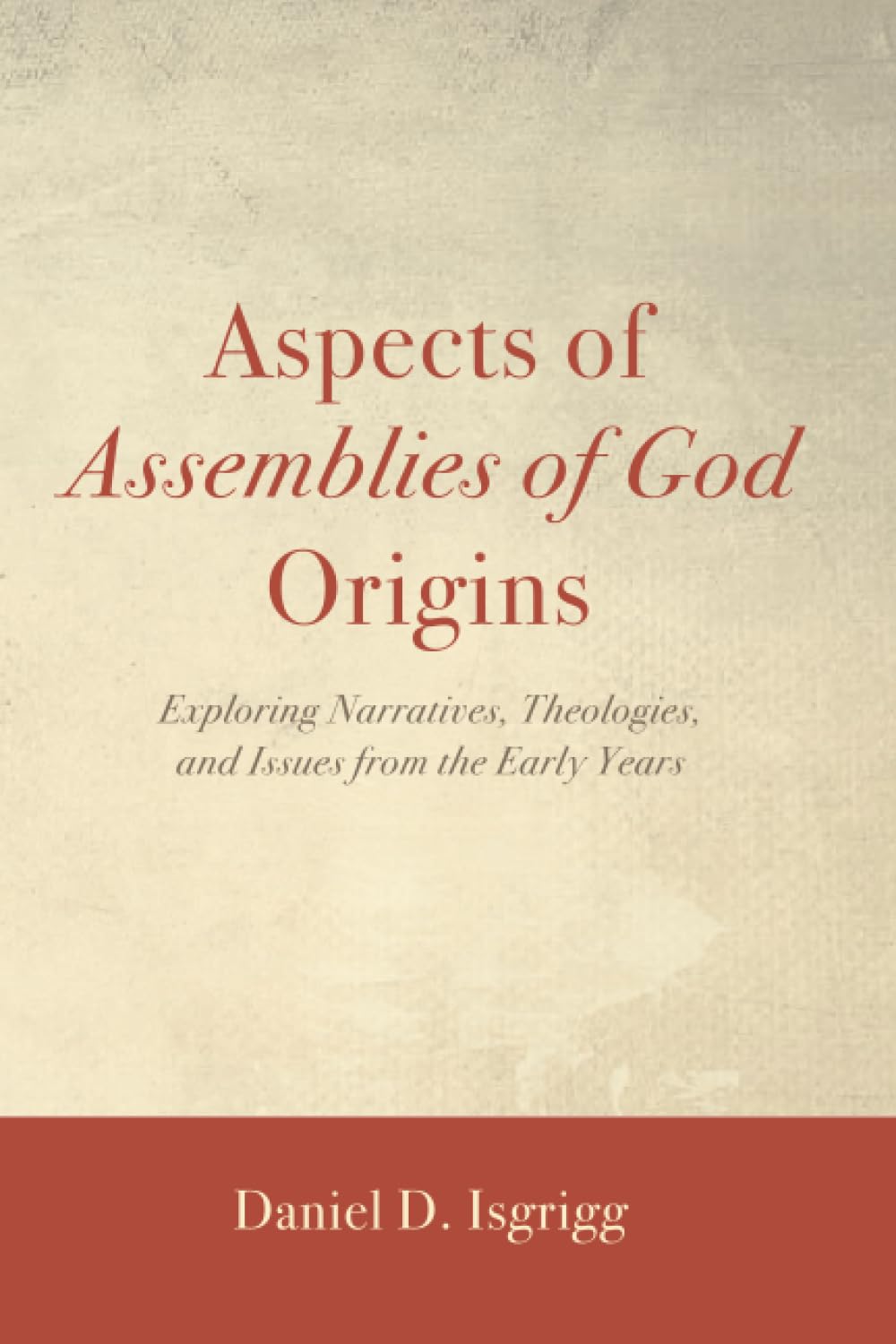
“Daniel Isgrigg’s previous work already put him at the forefront of a new generation of Pentecostal historians. His newest book challenges widely shared assumptions in Pentecostal history. I have rarely been this surprised.”
–D. Allen Tennison, theological counsel, National Office of the Assemblies of God
“Daniel Isgrigg produces a riveting and timely account of the Assemblies of God. Instead of a decade-to-decade rehearsal of events, he reimagines the Assemblies of God story by peering through critical theological, political, social, and ecumenical windows. Isgrigg argues persuasively that an honest history wrestles continuously with the evolution of theologies, alliances, and worldviews. He is both a sympathetic and dedicated insider, and a constructive critic.”
–Martin Mittelstadt, professor of New Testament, Evangel University
“History is, paradoxically, unalterable and in constant need of revision. The past does not change, after all, but we can change our understanding of it based on new facts or better interpretive frameworks. Daniel Isgrigg carefully examines stories (and myths) of Assemblies of God origins in this book, providing the kind of revision Assemblies of God history needs today.”
–George P. Wood, executive editor, Assemblies of God Publications
With the Assemblies of God now over a century old, my latest book on AG history, Aspects of Assemblies of God Origins, takes a fresh look at critical issues surrounding the AG’s origins. While not a comprehensive retelling, this book is a series of essays that explore different historiographical issues that will clarify or correct historical narratives with new research. Below are the topics covered.
The book has nine chapters, each exploring new research on these important theological and cultural issues to better understand its roots. Perhaps these conversations will help the AG better understand its history as the fellowship approaches the problems it faces today. Topics include re-examining the early relationship with the Church of God in Christ, assessing the AG’s evangelical identity, and attitudes toward theology and education. Here is a summary of each chapter.
Chapter 1: Aspects of AG Historiography – This introduction chapter looks at past AG histories through a historiographical lens, noting the various approaches of previous AG histories. These insights highlight the need for a critical evaluation of narratives about the AG and its early ethos.
Chapter 2: Aspects of the Name – This chapter reexamines the questions about why a group of white Pentecostal ministers led by Howard Goss and E. N. Bell used the name “Churches of God in Christ,” the same name as C. H. Mason’s black Pentecostal denomination. This issue first gained attention through an assertion by J.R. Flower in 1949 that Goss and Mason had an agreement to use the COGIC name to credential white ministers. This comment eventually shifted to a claim in scholarship that ministers who formed the AG left Mason’s COGIC group to start their own white fellowship. This chapter outlines the historiographical problems with the way scholars have framed this story. It also shows the lack of evidence for Flower’s claim and the counter evidence by early AG leaders that the 1914 formation of the Assemblies of God was not a racist abandonment of the “parentage” of Mason or his COGIC fellowship. Instead, it was a separate Pentecostal group navigating their own identity and choosing their own name at a time when Pentecostal groups were struggling to differentiate without becoming another denomination. This evidence is vital to revising this very important narrative about the AG’s origins.
Chapter 3: Aspects of the Finished Work – This chapter explores the development of the Finished Work stream of Pentecostalism. It gives historical insights into the controversy that created the stream and the theological consequences of this position. While most scholars note the presence of the two streams, they have yet to articulate how the finished work perspective works out in the various tenets of Pentecostal theology. The chapter traces the origins of finished work theology, gives insights into why the AG was the primary fellowship for finished work Pentecostals, and explores critical theological insights into finished work theology.
Chapter 4: Aspects of Evangelical Identity – This chapter discusses a conversation among scholars about the relationship between Pentecostalism and Evangelicalism. Because of the tensions between evangelicalism/Fundamentalism and Pentecostalism, some scholars argue that identification with these historic traditions have been detrimental. However, this chapter shows that the AG saw itself as evangelical believers who also believed in the Pentecostal baptism with the Spirit and speaking in tongues. This evangelical identity was expressed in literature, Bible school courses, and even resulted in an attempt to officially change the name of the Assemblies of God to “The Pentecostal Evangelical Church” in 1925.
Chapter 5 – Aspects of Eschatological Influences – This chapter goes more indepth into some eschatological influenced that shaped the early AG leaders that were not covered in my 2021 book Imagining The Future. As that book addressed, scholars continue to question the reason Pentecostals adopted dispensational eschatological frameworks from evangelicalism.
If dispensational premillennialism had this tension, then how did these frameworks make their way into the AG? This chapter attempts to answer that question by looking at the influential materials that Pentecostals were reading in which these views were communicated. It will discuss how these views influenced the eschatology of the AG through examining the works they promoted in the early years.
Chapter 6 – Aspects of Eschatological Variety – This chapter also builds on my previous work by going into depth into some of the earliest books on eschatology published by AG authors. It draws insights from early leaders that help to frame how eschatological variety was not only common but that various approaches were taken to different hermeneutical ways at looking at eschatological interpretations. It concludes with a timeline of eschatological works published by the AG.
Chapter 7 – Aspects of Theology and Education – This chapter tackles the complicated relationship the Pentecostal movement had with theology and the pursuit of education. Some scholars have interpreted this tension to mean that Pentecostals were “anti-intellectual.” This chapter explores early sentiments toward theology and education in AG ministers. It also charts the development of the AG’s various doctrine and theology books, documenting the different methodological approaches of doing theology as Pentecostals.
Chapter 8 – Aspects of Social Engagement – This chapter looks at the much debated characterization of Pentecostals as having a lack of social engagement because of their eschatological beliefs that Jesus is coming soon. This chapter explores how the AG’s premillennial beliefs affected how they interpreted economic, racial, political, and social issues. It demonstrates the variety of ways that AG ministers not only recognized social issues, but actively worked to engage those issues with ministry.
Chapter 9 – Aspects of Future Research – This chapter concludes the volume with insights into various gaps in the study of the AG. It suggests areas of research that still need to be explored to better understand the AG and its rich history.
I hope this book will clarify various aspects of AG origins as the fellowship grows in its understanding of its past so it can navigate the challenges of future.
 Daniel D. Isgrigg
When and where can I purchase this book?
Thank you!
Pastor Gene Allen
Hi Gene. At any online seller. Here is the Amazon Link, https://www.amazon.com/Aspects-Assemblies-God-Origins-Narratives/dp/1666760978/
Pingback: 2024 in Review | Daniel D. Isgrigg
Pingback: The Assemblies of God is NOT a “White” Pentecostal Denomination | Daniel D. Isgrigg
Pingback: A New Assemblies of God History | Daniel D. Isgrigg