Oral Roberts University has many iconic architectural features. From the iconic Prayer Tower, to the towering pillars of the Learning Resources Center, to the City of Faith (City Plex Towers), the campus architecture has a national reputation as one of the most unique campus designs.
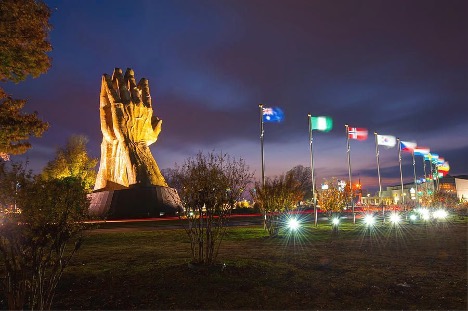
But when people think of ORU, they think of the giant sculpture of two hands touching in prayer at the main campus entrance. A popular spot for campus visitors, these iconic bronze hands stand 60 feet tall and weigh over 30 tons, featuring fingers that are 20 feet long. They hold the world record for the largest praying hands in the world.
The sculpture has often been called “the praying hands” because of its similarity to other praying hands images. While prayer is certainly part of the symbolism, their official name is “Healing Hands” because they are intended to reflect a specific concept of healing unique to ORU.

Healing Hands
Oral Roberts University (ORU) was birthed with a vision that its students would take God’s healing to “every person’s world.” This was rooted in the idea Oral Roberts’ theology of healing could be lived out within various professional disciplines. For Roberts every profession could become an avenue for healing humanity. As this concept matured, ORU began adding graduate schools in the late 1970s including medicine, law, theology, and business.
This is where the hands come in. In 1977, ORU began its School of Medicine and started construction on the City of Faith Medical and Research Complex. The City of Faith was an innovative concept that sought to combine the best of medicine with belief in healing prayer.
God said to Oral Roberts:
“Build me a medical school at Oral Roberts University. I want a stream of my healing power to constantly flow out of ORU through prayer and medical science as well. I want you to raise up Christian doctors who will accept my healing power in its fullness. They will do all they can through prayer, and they will do all they can through medicine.” (Abundant Life, February 1977)

This idea is exemplified in the giant “Healing Hands” that once sat in front of the City of Faith. The hands were surrounded by a long water feature. The symbolism was that of God uniting two streams of healing: one hand of prayer with the other hand of medicine. That was the vision for the City of Faith.
While the experiment of the City of Faith ultimately ended in 1989, the idea of healing through medicine has persevered and has been implemented in many medical settings.
Whose Hands?
The unique architecture of ORU often sparks speculation about the meaning behind its symbolism, particularly regarding the Healing Hands. Many assume the hands are models of Oral’s own hands. Others suggest that one hand represents Oral Roberts’, while the other symbolizes his son Richard’s. But the truth is actually a bit more complex.
In some ways, the hands represent Oral Roberts’ hands. When the vision came to Roberts, God said to him:
“In the Healing Hands, the right hand will represent the healing stream of MY power through prayer; the left hand will represent the healing stream of MY power through medicine – the hands joined will represent unifying of the healing streams of prayer AND medicine as they both reach up to touch the hands of Me, the Great Physician, the Source of all healing and health.” (Abundant Life, October 1977)
The “My” in this vision does not refer to Oral; it refers to Jesus. Oral never claimed to possess healing power; instead, he always pointed to Jesus as the true healer. He believed that his hands served as a conduit for Jesus’ healing touch. In this way, while the Healing Hands do somewhat represent Oral’s hands, they ultimately represent Jesus’ hands. The two hands are Jesus’ healing power, and God’s gift of healing through medicine.
If symbolically they represent Jesus’s hands as an extension of Oral’s hands, then were Oral’s actual hands the model for the sculpture? Interestingly, no.
The sculpture was created by Leonard McMurry, a well-known Oklahoma artist and sculptor, and a member of the Oklahoma Hall of Fame. His works are well known in Oklahoma and include the Legend of the Great Westerner in OKC and a series of busts of Oklahoma Governors in the Capitol.

The actual hands used as a model for the sculpture were those of Gary Mitchell, a childhood friend of McMurry. At first, McMurry wanted to use Oral’s hands, but Oral declined because he felt like his hands were too old by that time (he was in his 60s). Instead, McMurry called on a close friend to be the model. McMurry meticulously patterned every wrinkle, vein, and muscle on Mitchell’s hands.
After creating the prototype, McMurry traveled to a foundry in Mexico to produce the casting. This process took several months to complete. The next challenge was delivery and assembly. A convoy of trucks brought the sculpture’s pieces to Tulsa, where it took additional months to assemble everything correctly. In total, it took three years from start to finish to create the iconic Healing Hands sculpture that is now widely recognized.

After the City of Faith closed, the sculpture was moved to the main entrance in 1991. Today, the sculpture sits at the entrance of ORU among the Avenue of Flags. They showcase that healing can extend to every person’s world through Spirit-empowered higher education.
ORU’s Healing Hands are recognized as the largest praying hands in the world. According to several travel and art websites, it is also the largest sculpture in the world. For ORU, it is a reminder of not only the history of healing but also the legacy of the idea that the best of education, research, and professional disciplines, when combined with prayer, will bring God’s healing into every person’s world.
 Daniel D. Isgrigg