The shift to readily accessible Artificial Intelligence tools is changing how our society operates. This revolution is having a significant impact on higher education. As a faculty member, the topic of AI comes up regularly in our meetings. No doubt, it’s here to stay.
As a professor, people are often curious about how students use AI for their papers and how challenging it is to grade with this new technology. The truth is that students have always found ways to shortcut the research and writing process. AI is just a new avenue for that shortcut. For that part, although it’s a problem, it’s probably not as prevalent as one would expect.
One thing I tend to see more often is what industry leaders are calling “work slop.” There are students who submit AI-generated work containing inaccurate and misleading information. Sometimes they turn in content that may have little to do with the assignment because they relied on AI. This is actually easier to catch than plagiarism is.
As I teach research classes for our college, I feel responsible for training our students to use AI in an ethical and responsible manner. In many ways, AI tools can be helpful to today’s students. I have found that using it myself is the best way to recognize how others are using it. I know what it does well, and I know what it doesn’t.
I have also enjoyed learning to use some of these tools. I am no expert, for sure, but as a professor, I thought I’d share some of the ways I have leveraged this tool in my work.
AI as an Editing Tool
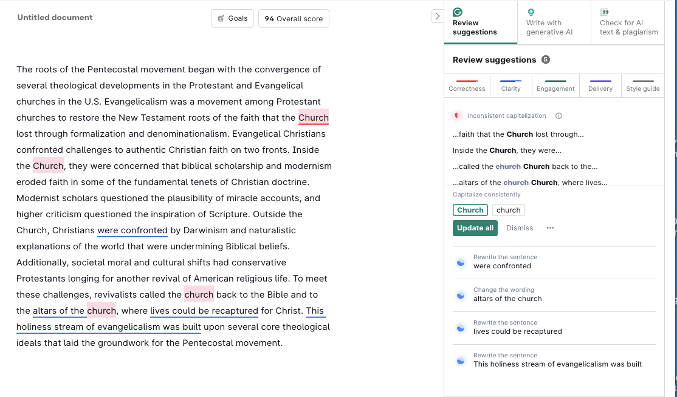
One of the best uses of AI is in programs like Grammarly that help improve writing. I use that function every day with everything I write. I teach my students this principle: “You can’t use AI to write for you, but you can use AI to improve what you have already written.” Grammarly is a low-level AI tool that helps me write better because it always shows me how my sentences can be improved. I accept many of its suggestions. Others I reject. However, I now view writing differently, as the tools are revealing to me (even as I type this) what is wrong with my wording, sentence structure, and punctuation use (which I corrected with Grammarly!). I make my students use it to save me the hassle of having to grade sloppy writing.
AI as a Research Tool
The essence of research is the ability to locate information effectively. Library databases and free tools, such as Google Scholar, have been invaluable resources that guide students in finding information using effective search logic.
People are now turning to AI as a quick way to do research. However, I have found it somewhat inadequate in its ability to replicate traditional research methods. As a general research tool for information, it can be a helpful resource. However, as a precise tool for higher-level academic research, it still has a long way to go.
What it does well is provide great information on concepts and ideas. Often, when I come across a concept I am not familiar with, or I need reminders of what certain scholars or works are known for, I use it to provide a good summary and some sources. The summaries it can generate are more effective than sorting through millions of results on Google. But they always have their limits, as most academic information is not widely available for the AI to draw from. Discernment and information literacy are always necessary.
But there are also big pitfalls for academic research. AI is notorious for creating sources that do not exist. This happens regularly with tools like ChatGPT, which hallucinates sources if it does not have a good answer. Below is an image of when I asked ChatGPT for a list of the top academic sources on Pentecostal worship. Every one of them was false. Unfortunately, students are citing sources that do not exist because they used AI as a shortcut.
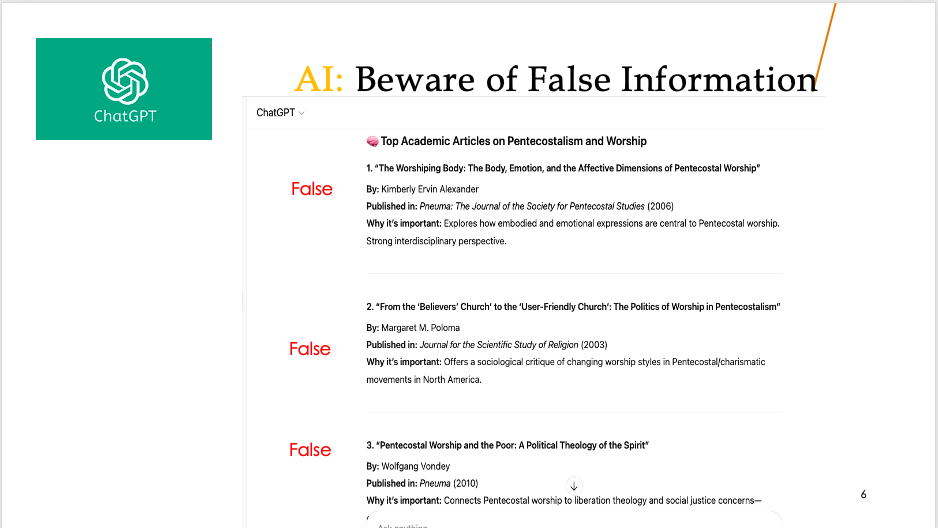
AI models have the ability to find scholars’ names and assign plausible titles based on the prompt question. The sources they come up with often sound credible, but they often do not exist. While AI is improving, this poses a significant danger to students. I make sure to show them this and emphasize that traditional library tools, such as Ebsco databases or Google Scholar, are still much more effective and reliable.
AI as an Analysis Tool
One of the most impressive features of AI is its ability to process data. AI tools have the ability to identify patterns in both hard and soft data, leveraging the extensive knowledge base of the program. It can be highly effective in analyzing data and generating stats or graphs based on the data.
This past year, I have been working on two qualitative research projects involving religious testimonies. I was able to use CoPilot to help me document and analyze those testimonies in a fraction of the time that it would have taken me to do it manually. I have used AI to analyze testimonies, generate master spreadsheets of the data, code data, and derive insights from the data.

Of course, if you use tools like this, you cannot rely on this by itself. You must review the data yourself, using your own expertise, to identify any items that may have been missed. There were certainly things it didn’t catch and concepts specific to theology that it didn’t recognize, but overall, it did a good job of helping me organize the data into meaningful categories as a starting point that I could build my research upon.
On the other side, sometimes my use of AI made the project more complicated. A couple of times, I asked AI to help me with projects that would have been much easier if I had investigated them myself. Glitches in the system or the actual quality of the final product took a lot of time to process, but it was not really what I wanted. In these cases, “workslop” was a reality of my AI use.
I learned from this that investigating things through traditional methods first is often more effective than relying solely on AI for help. Our brains are still the best search and research tools because we know what we are looking for. We were created to wonder, to ponder, and to problem-solve. We cannot surrender that process to AI to do for us. But it can help in many ways.
AI is a Tool, not a Solution
If I could summarize the value of AI, it would be this. AI is like having a supercomputer at your disposal. It can be a powerful tool. However, I also think it’s far more limited than the hype suggests. It’s not an ultimate solution that will become the be-all for our generation. Not everything needs AI. Instead, I try to help my students understand where it helps and where it hurts.
We still need to be curious, to use our own critical thinking, and to wrestle with information to find the answers we need, rather than relying on AI. But I have learned to embrace these tools as helpful and effective, even for theology professors like me.
 Daniel D. Isgrigg
Your work with analyzing religious testimonies sounds like a fantastic use of these tools. Qualitative research can be so incredibly time consuming when you are trying to find patterns in hundreds of personal stories. Having an AI help with the initial coding and organization must have saved you weeks of manual labor. It is a great reminder that the best way to use this technology is to have it do the tedious sorting so the human expert can focus on the actual theological insights.