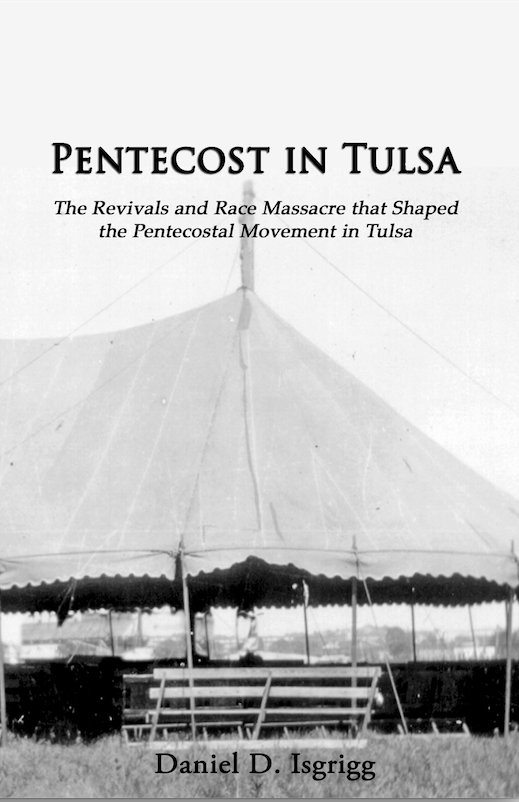
In my 2021 book Pentecost in Tulsa, I tell the story of Tulsa’s Pentecostal history. While conducting that research, I experienced two parallel realities. Finding and documenting sources on Tulsa’s White churches is fairly easy, thanks to the extensive record of Tulsa’s white Pentecostal churches in magazines, denominational minutes, and city newspapers.
However, finding historical information on Tulsa’s black Pentecostal churches was extremely challenging. There are only scant mentions of black churches and ministers in public records, city directories, and newspapers. Denominational materials are also very hard to find from the early 1900’s.
One key that unlocked some of the story of Greenwood’s Pentecostal churches was garnered from eyewitness testimonies and oral histories related to the 1921 Tulsa Race Massacre.
While the official riot commission documented 6 churches that were destroyed in the massacre, my research found there was at least one Church of God in Christ in Greenwood. COGIC is a large Pentecostal denomination started by Bishop C. H. Mason.
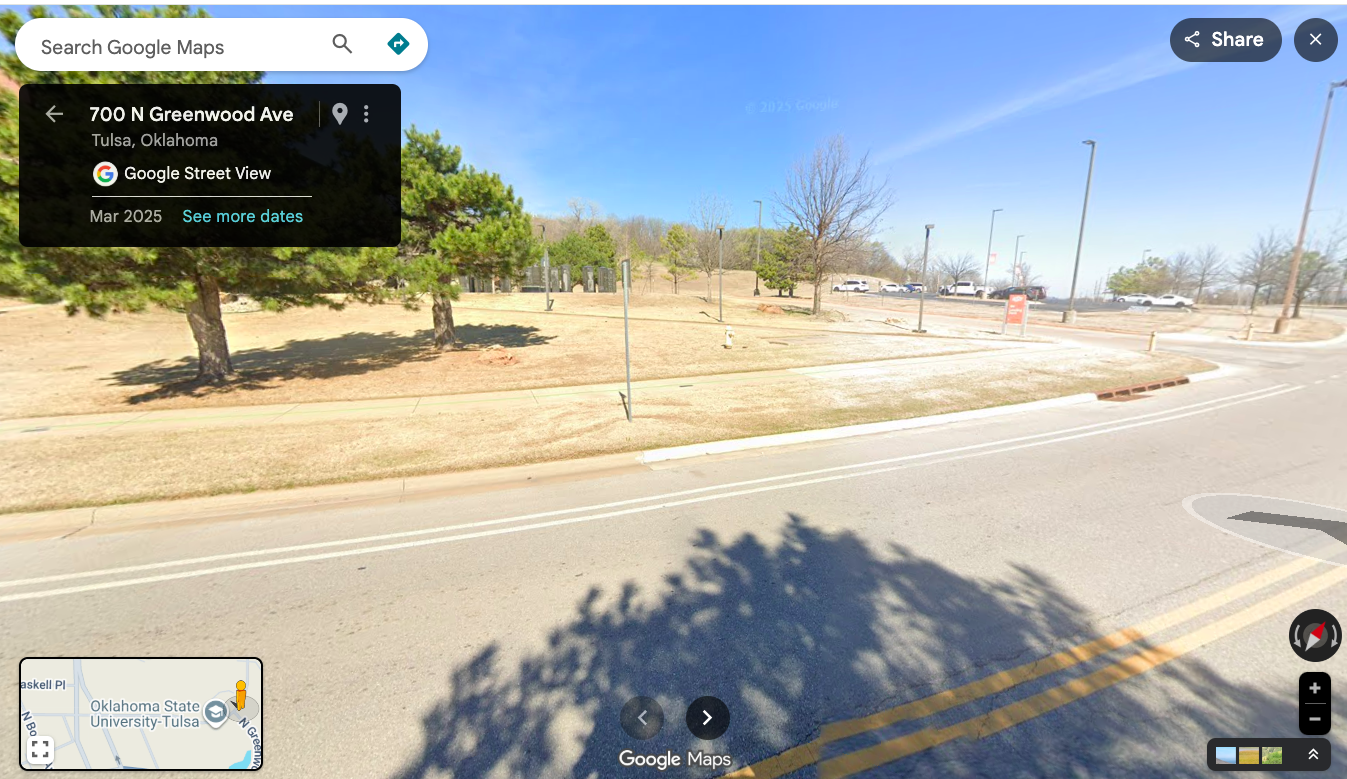
I first discovered information about this church from the testimony of Civil Rights pioneer, Ada Lois Sipuel Fisher. She notes that her father, Bishop T. B. Sipuel, pastored a COGIC church at 700 N. Greenwood that was also affected by the destruction of that day. I also found mention of that church at 700 N. Greenwood in the Polk Hoffine City Directory in 1920 and 1922. The location of that church was approximately where the north parking lot of OSU Tulsa stands today.
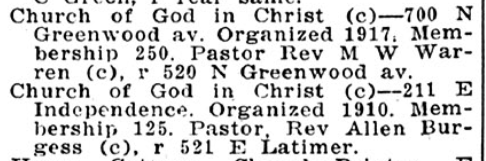
However, the Tulsa city directory also indicates there was a second Church of God in Christ church led by Pastor Allen Burgess at 211 East Independence, at the same time. This was a mystery to me. How could there be two churches within less than a block from each other in 1922? I wasn’t exactly sure how this church related to the story of Sipuel, since the directory never mentions Sipuel. Was it the same church? Additionally, I found no references to Allen Burgess in COGIC sources, so I wasn’t sure how accurate the city information was. I assumed at the time that it was the same church and that the information on the pastor was just incorrect.
Two COGIC Churches?
In the midst of this confusion, I discovered the riot survivor testimony of Eldoris Mae Ector McCondichie. In a recording of her testimony on from the Riot Commission, she mentions she went to the little white “Church of God and [sic] Christ” church “on a hill on Independence Avenue.” She names her pastor as “Rev. Bugress.”
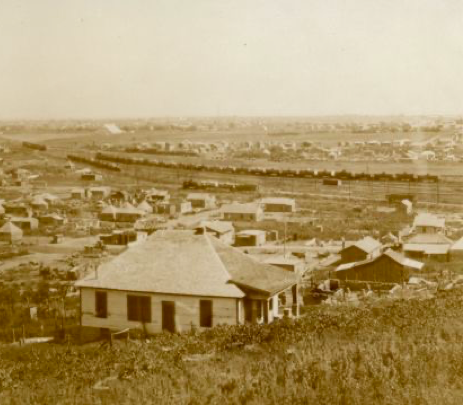
McCondichie’s testimony about this COGIC church is very different from what Sipuel said happened to his COGIC church. She says that when rioters tried to burn her church building, by a miracle, it did not catch fire. She said, “There was no serious damage to the church, just a black smear on the wall. Our minister, Rev. Burgess, would never let us paint over that smear. He wanted it left for. us all to see. He said it was a gift from God to us.”
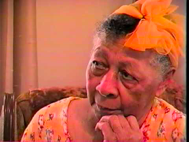
By identifying Allen Burgess as the pastor of the Church of God in Christ on Independence, McCondichie solved the mystery and confirmed the city directory that listed two COGIC churches in Tulsa in 1921, not one. One survived, the other did not. These details that I found only after publishing the book, were published in an article in Fall 2022 issue of the Oklahoma Historical Society journal, Chronicles of Oklahoma.
(Her testimony is captured in the OHS Riot Commission transcripts and YouTube Videos. However, the transcript of her testimony can be found in Eddie Faye Gates’ book, Riot on Greenwood, on page 85-87.)
Some time later, I also uncovered the mention of Pastor Allen Burgess in Glenda Goodson’s book, Mason’s Texas Children, a history of the Page Normal Industrial and Bible Institute. In the appendix is an account from COGIC Bishop E.M. Page. Page mentions that sometime after 1914 he “sent Elder Burgess to the church at Tulsa Oklahoma,” which had been pioneered by Brother Mathis, Sister Fudgett, Sister Elijah, Sister Prescott, and Sister Warren (wife of M. L. Warren). These two pieces of information confirmed that there were two COGIC churches in the Greenwood area of Tulsa during its hayday as Black Wall Street.
Pastor Allen Burgess’s Fate
McCondichie’s testimony also gives us insight into Pastor Burgess’ fate and why I didn’t find his name in COGIC sources. Though the church survived the attempted assault and arson, McCondichie recalls how traumatized Burgess was by the violence to the community.
“Everyone said that the terrible riot killed our minister as surely as if he had been shot or burned. His heart was so saddened by what he saw. He just couldn’t live with it.”
The scars of fire remained on the building and made their mark on Burgess and the members of that church. During a service a few months afterward on December 14, 1921, Burgess got up to pray, sang a song, then gave his Bible to another minister, sat down, and died. He left his widow, Martha, and his congregation behind to rebuild from the scars of fire of that day.
Rebuilding COGIC in Greenwood.
In the midst of the devastation, Greenwood Pentecostals turned to their faith in God and to the church. In 1922, the church on Greenwood is not listed, but the church on Independence is mentioned and led by M. L. Warren. This suggests that with Sipuel moving to Chickasha and the Greenwood building being destroyed, the two churches likely merged. By 1922, the COGIC church grew from 140 to 250.
By 1925, the Church of God in Christ was in the hands of Elder William G. Strassner. Pastor Strassner, his wife, Eliza, and their children—Roosevelt, Howard, Roy, and Lucille—lived in a home near the church. In 1925, he also led the Sand Springs COGIC church, which had previously been led by Pastor Malachi Green. Strassner pastored both churches with J. A. Jones is serving as assistant pastor in Sand Springs, and with the help of Luke Davison, E. Franton, and Brother Nicholson. Strassner also served as the overseer for Tulsa district churches.
Strassner’s tenure as pastor ended in 1928 when a dispute arose that brought the church and Strassner to district court. Interestingly, it was B. C. Franklin, the prominent Tulsa lawyer, who was assigned by the district judge to arbitrate the case. The story made national news as it was the first time an African American was appointed as “master in chancery” south of the Mason-Dixon Line. The split with the church is likely the reason the church moved from the building on Independence to its current location at 1415 North Greenwood.
While the Tulsa Race Massacre was horrific and tragic, the testimonies give us details about Tulsa’s history we would not have without it. I am so grateful to Eldoris McCondichie for sharing her story with Eddie Faye Gates and the Commission team. Without it, we would not know Tulsa’s Pentecostal history.
For more, see my book Pentecost in Tulsa.