Matthew 24 is a favorite passage for end-times prophecy enthusiasts. Prophecy teachers have used these descriptions of false messiahs, tribulation, wars, pestilences, and other apocalyptic signs to determine whether the present troubles of the world are close to fulfilling Jesus’s prophetic words about the end times. For most, Matthew 24 is a prophecy of the future.
It should come as a surprise, then, that a former General Superintendent of the Assemblies of God held a view of Matthew 24 that was not futurist. Ralph M. Riggs was the 8th General Superintendent of the Assemblies of God, serving from 1953-1959. His book, The Spirit Himself, is among the best-known publications of the AG publishing house in his era.
But Riggs’ earlier book was focused on eschatology. In 1937, he published his GPH book, The Path of Prophecy. This was one of the first books the AG published to address Bible prophecy and was the first eschatology book by one who would serve as General Superintendent.
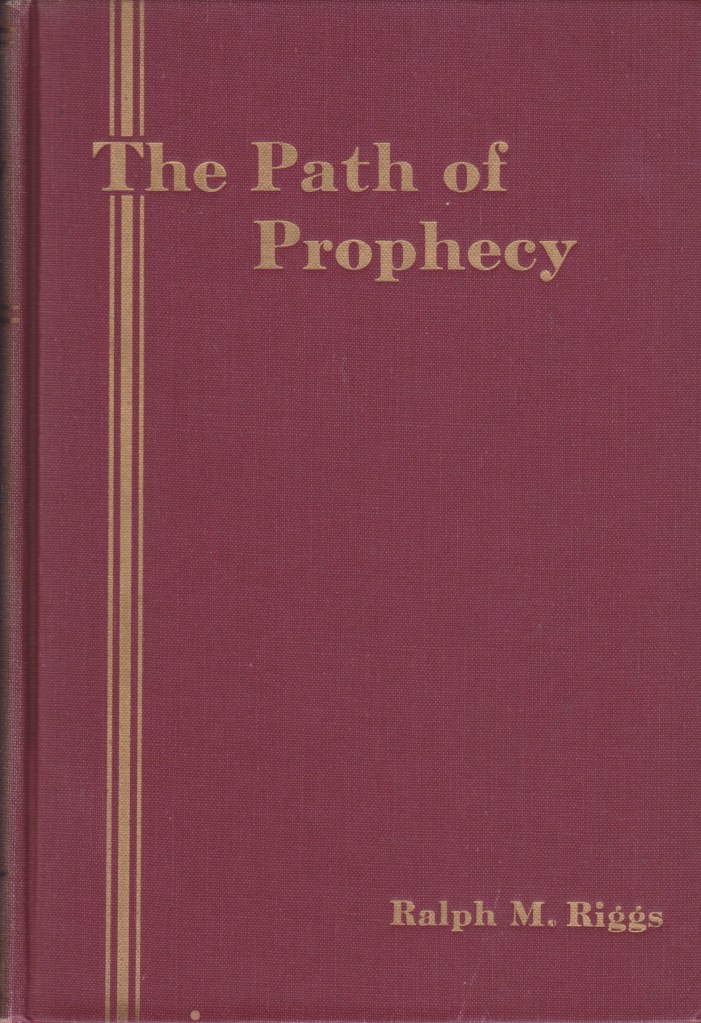
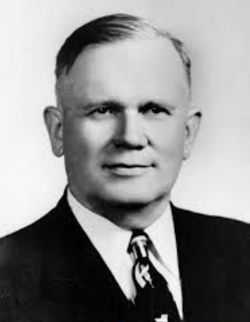
Riggs’ approach to prophecy focuses on the “story of the future” rather than on interpreting every detail. Yet, for the most part, his book mirrors the other dispensational approaches found in many Pentecostals of that era. At the same time, Riggs notes that figures of speech should not be interpreted literally when not warranted by the text. While he prioritizes the “literal meaning,” he warns against interpreting symbols literally. [1]
Because of this hermeneutical approach, Riggs calls for charity in prophetic views. He argues that those who study prophecy must do so with” humility, diligence, and regard for teachers that the Holy Spirit has used to teach the subject.” He rejects the idea that prophecy teaching is settled by one perspective. He says, “Differing viewpoints can be respectfully listened to, compared with various statements of the Divine body of Prophecy, spread before the Lord in prayer, and accepted to that degree to which they harmonize with the Scripture and received the witness of the Spirit.”[4]
This openness to interpretive views is on full display when Riggs takes a historicist view of Matthew 24. Whereas most futurist interpreters see the “signs of the times” prophecies of wars, tribulation, earthquakes, false christs, etc., found in the Olivet Discourse as future fulfillment, Riggs does not.
Riggs argues that Matthew 24 is prophecy, but specifically a prophecy by Jesus to Israel about the Destruction of Jerusalem by the Romans in 70AD. Unlike other OT prophetic scriptures that he sees as having a double fulfillment, Riggs places this particular discourse as fulfilled solely in the past.
Riggs points to twenty-five different prophecies given by Jesus in Matthew 24 that he argues were all fulfilled in the Jewish-Roman war “during the lifetime of the generation to which he spoke.” [5] Riggs does not seem to give room for the double fulfillment or future fulfillment of these passages. He says, “In the destruction of Jerusalem by Titus, the Roman general, in 70 A.D., every single one of the features of this prophecy was fulfilled.”[6] In this way, when Jesus says “This generation will not pass away…” he meant it literally, and it applies to the first century alone.
“In the destruction of Jerusalem by Titus, the Roman general, in 70 A.D., every single one of the features of this prophecy was fulfilled.” Ralph Riggs
One key support to this argument that Riggs gives is that the Gospel of John “does not contain this prophecy.”[7] His point, I share and have expressed in my early writings on Revelation. Although John is the same person who wrote the Apocalypse (The Book of Revelation), the Gospel of John contains no apocalyptic discourses that are found in the Synoptics.
But the biggest support for Riggs’s view comes from his reading of early church history books, including the works of Roman historians Josephus and Tacitus. The historical accounts of the Jewish war with the Romans and the destruction of Jerusalem align with Jesus’s prophetic utterances to great specificity. Therefore (much like the early church fathers), Riggs sees Matthew 24 as historically fulfilled, not a dispensational prophecy of the future, as many prophecy teachers continue to teach today.
This view of the prophetic utterances of Matthew 24 is what we would call a “historicist” view of prophecy. Rather than describing a future time of great tribulation, historicists view Matthew 24 as a prophecy about the coming judgment upon Jerusalem that signals the “end of the age” of the temple and ushers in the age of the Messiah.
While other parts of Riggs’s view of prophecy are futuristic, this historicist view sheds light on the variety of eschatological views found in the history of AG interpreters of eschatology. I give more examples of this variety in a chapter titled “Aspects of Eschatological Diversity” in my book Aspects of Assemblies of God Origins.
For related discussions, see this blog post with interesting insights into AG Eschatology from my book, Imagining the Future.

[1] Riggs, The Path of Prophecy, 31, 110–11.
[2] Riggs, The Path of Prophecy, v.
[3] Riggs, The Path of Prophecy, 24.
[4] Riggs, The Path of Prophecy, 26–28, 110–11.
[5] Riggs, The Path of Prophecy, 101.
[6] Riggs, The Path of Prophecy, 102.
[7] Riggs, The Path of Prophecy, 101.


This is so cool! I love how you’re highlighting the diverse views of various AG leaders throughout our history!
Thanks Audrey! And thanks for reading. I love finding these things that help us as a fellowship widen our tents.
The only thing about with this is. . . it’s too short!
How much push-back did Ralph Riggs get from his futurist brethren? It much not have been too much, since he later was elected General Superintendent.
Oh for more men like him!