With the 250th anniversary of the United States underway, a number of Christian leaders have organized events and prayer initiatives to commemorate the anniversary. Many of them are calling on the country to celebrate its Christian heritage and renew a commitment to God in our nation.
At the same time, there is a national debate, including among Christian historians, about America’s Christian heritage and the meaning of America’s founding value of religious freedom. The topic of “Christian nationalism” is a hot topic right now.
My studies of Pentecostal history have often led to surprising discoveries about how Pentecostals have viewed the question of how “Christian” government can be and how the church should be involved. It also revealed some surprising positions I wasn’t aware of, affirming the “separation of Church and State.”
This blog examines historical evidence that, until the 1980s Conservative revolution, Pentecostals viewed the separation of Church and State as a key pillar of Pentecostal doctrine and a value worth defending.
Early Pentecostal Suspicion of Government
Early Pentecostals had a variety of views on just how political Spirit-filled believers should be. Some believed Pentecostals should not be involved at all. But for the most part, most early Pentecostals were suspicious of political engagement. In their mind, their view of the biblical prophecy held that all governments were human instutions (not holy).
They were particularly leery of democratic republics like the USA, which were doomed to eventual control of the antichrist. James McAlister comments, “Democracy means to govern without Christ, and will therefore prove the biggest failure of all forms of government.”(Pentecostal Evangel, September 1920) (See more about the AG’s eschatological views in my book Imagining the Future)
Pentecostalism began in the years lead-up to the First World War. Reports that Germany was a “Christian nation” were intended to solicit public support. Pentecostals were not buying it. The war was not “Christian.” In fact, because of this conviction, some Pentecostals rejected the idea that governments or nations could be “Christian.” One writer put it this way:
“There is not, and has never been, such a company of people as a CHRISTIAN NATION, and never will be until the Lord Comes.”(Pentecostal Evangel, July 1, 1916).
Similarly, G. F. Taylor wrote: “A higher application of [idolatry] lies in the doctrine of the union of church and state. The state is corrupt, and when the church unites with it, the church is always corrupted.” (Pentecostal Holiness Advocate, April 17, 1919)
The Church of God (Cleveland, TN) was the first Pentecostal denomation to affirm that its members should vote, but it affirmed it was “Opposed to the union of Church and state under any circumstances.” (General Assembly Minutes, 1908)
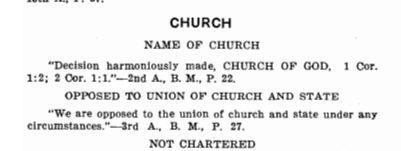
Even more poignant, in 1917, the Pentecostal Holiness denomination passed a position affirming absolute separation of Church and State:
“The absolute and eternal separation of Church and State is a fundamental principle in the constitutional law and polity of the American nation, and unqualified loyalty to this principle is essential to its preservation and welfare in all departments of government, both state and national, and the Pentecostal Holiness church affirms its adherence to said principle and polity without reservation.” Discipline of the Pentecostal Holiness Church, 1917
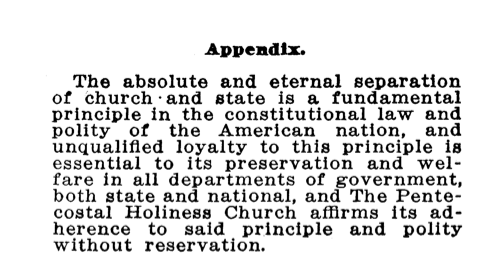
They further went on to say they opposed the Roman Catholic Church “…or any other ecclesiastical body, seeking to control any or all branches of government in its own interests, which we deem contrary to the fundamental law of our national and state constitutions.”
Myer Pearlman discusses this issue in 1934 in an article on how loyal Christians should be to the government. He argued that Jesus’ kingdom teachings made it clear. Jesus advocated for that separation in his teachings. Pearlman said, “Separation of Church and State and loyalty to each in its own sphere is [Jesus’] answer” (Pentecostal Evangel, June 16, 1934).
Evangelical-Era Responses to Church and State
When Pentecostals joined the National Association of Evangelicals in the 1940s, one of the key tenets that was affirmed was the separation of Church and State. NAE was formed, in part, to unite Evangelicals against the perceived encroachment of the Roman Catholic Church on American government.
While this sentiment was driven by anti-Catholic bigotry, their position was unequivocal. The State cannot be controlled by the Church. America is a free religious nation founded by people who were Christians, but not one controlled by any religious group, including Christian religious groups.
In 1942, General Secretary of the Assemblies of God, J. R. Flower, urged all AG ministers to embrace the NAE because of this position. He said,
“This association is being formed for the purpose of uniting those who are true to the inspiration of the Scriptures and the Fundamental doctrines of the Christian faith in matters which are common to all, including the separation of church and state….No religious bodies are required to register in Washington, for in the United States of America there is religious freedom and a complete separation of church and state.'” (AG Ministers Letter, September 21, 1942).
In 1958, an article was published in the youth magazine for the Assemblies of God praising Jefferson for his “amazing” contributions to the US, which were, in particular, the separation of Church and state. (CA Herald, July 1958)
While many today distance the First Amendment from Jefferson’s emphasis on church-state separation, Pentecostals saw this as exactly what the founders envisioned. These positions showed that the separation of Church and State was a GOOD thing for the church, and good for America.
Official Pentecostal Doctrine: Separation of Church and State
Finally, history leaves us with three major Pentecostal denominations in the 1960s, all members of the National Association of Evangelicals, who passed resolutions affirming the fundamental American principle of the separation of Church and State.
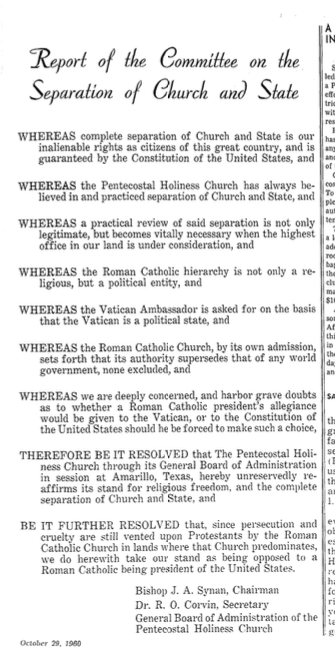
In 1960, the Pentecostal Holiness Committee on the Separation of Church and State issued these words affirming the “complete separation of Church and State.”
Similarly, the Church of God (Cleveland, TN) passed a 1942 resolution re-affirming its 1908 position about the church-state separation.
“That the Church of God is definitely opposed to any form of dictatorship in matters pertaining to state and civil government. We heartily endorse the democratic way of life and faithfully pledge ourselves to its support, maintenance and progress.”
In 1960, the General Council of the Assemblies of God adopted this statement affirming “religious freedom and absolute separation of Church and State.”
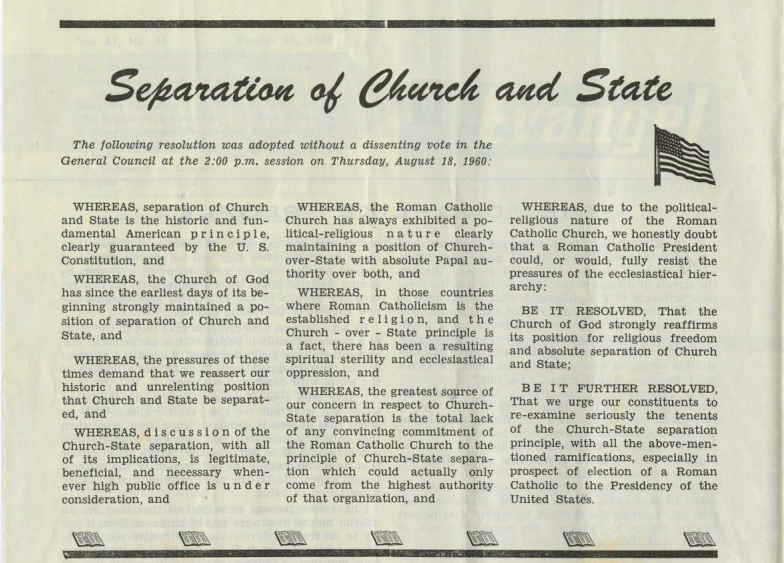
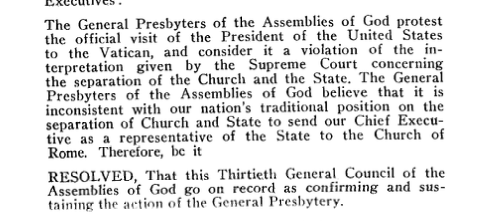
The Assemblies of God passed another resolution in 1963. This was largely due to the NAE position, which was promoted by the General Superintendent Thomas Zimmerman, who was also the NAE’s head. The council produced this statement when a visit by the president to the Vatican was deemed unacceptable due to the “separation of the Church and State.” (Assemblies of God, General Council Minutes, 1963)
Conclusion
It is clear that most Pentecostals, up until the modern era, believed that the separation of Church and state was good for the Church and good for America. They believed that the founders knew that the best thing for America was religious freedom. The church-state separation was absolutely essential to this.
While they did believe America had a Christian heritage, they did not want any church dictating or controlling government, especially the Catholic Church. It was clear that they believed the purpose of the First Amendment was to keep the church from controlling the state as much as to keep the state from controlling the church. It was not “one directional” as some view it.
This position is actually not surprising considering that most Pentecostals left denominations to enjoy the freedom of Pentecostalism. They certainly didn’t want any denomination making people worship in ways that violated their freedom of conscience and freedom of biblical interpretation. State churches were tools of the antichrist, not Christianity. They were opposed to Catholic, Anglican, Reformed, or any sect of Christianity imposing its beliefs on them. Therefore, religious freedom was paramount.
Pentecostals believed that Christians should vote, be good citizens, vote for Christian values, and serve in governmental positions. (See my chapter on this development in my book Aspects of AG Origins). But they did not advocate for making America into a Christian nation. A nation of Christians? Yes. A Christian nation? As the early writer pointed out, that was an impossibility until Jesus comes. The only “Christian” government will be when Jesus sets up his kingdom in the Millennium.
It is with this history in mind that I suggest that Pentecostals should carefully consider how to view the current efforts to view America and its history.

