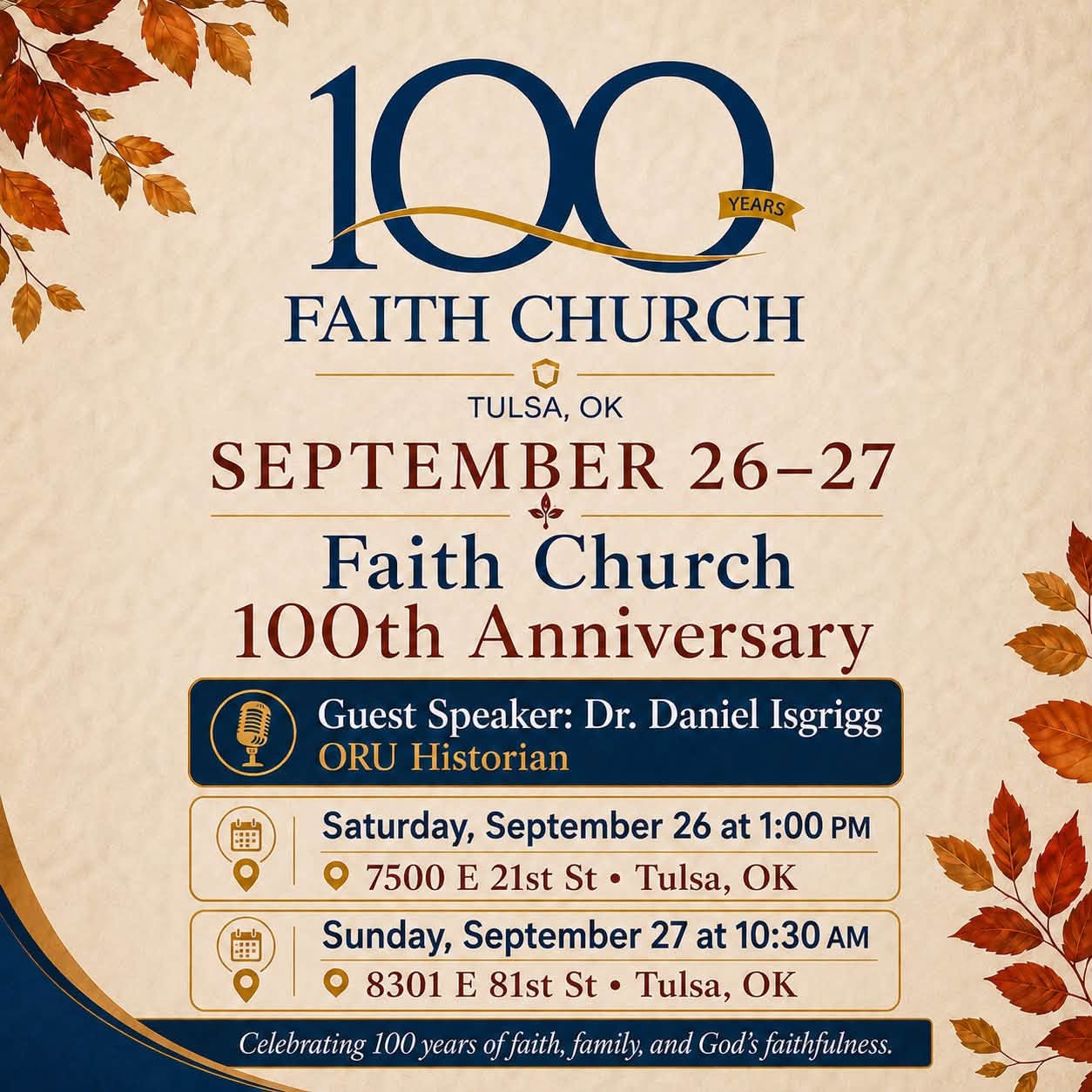
Faith Church in Tulsa, Oklahoma, is celebrating its Centennial on September 26-27th with several celebrations. This Assemblies of God church has a deep history in Tulsa of proclaiming the gospel and serving the Tulsa community. Its roots go deep in the revival history of Tulsa.
Faith Church’s story begins with the 1923 Raymond T. Richey Revival. In March 1923, the Tulsa Ministerial Alliance invited Richey to the city. Led by radio pastor, William Kitchen, the multi-denominational committee solicited funds to build a tabernacle to accommodate the crowds during the seven-week campaign.[1]
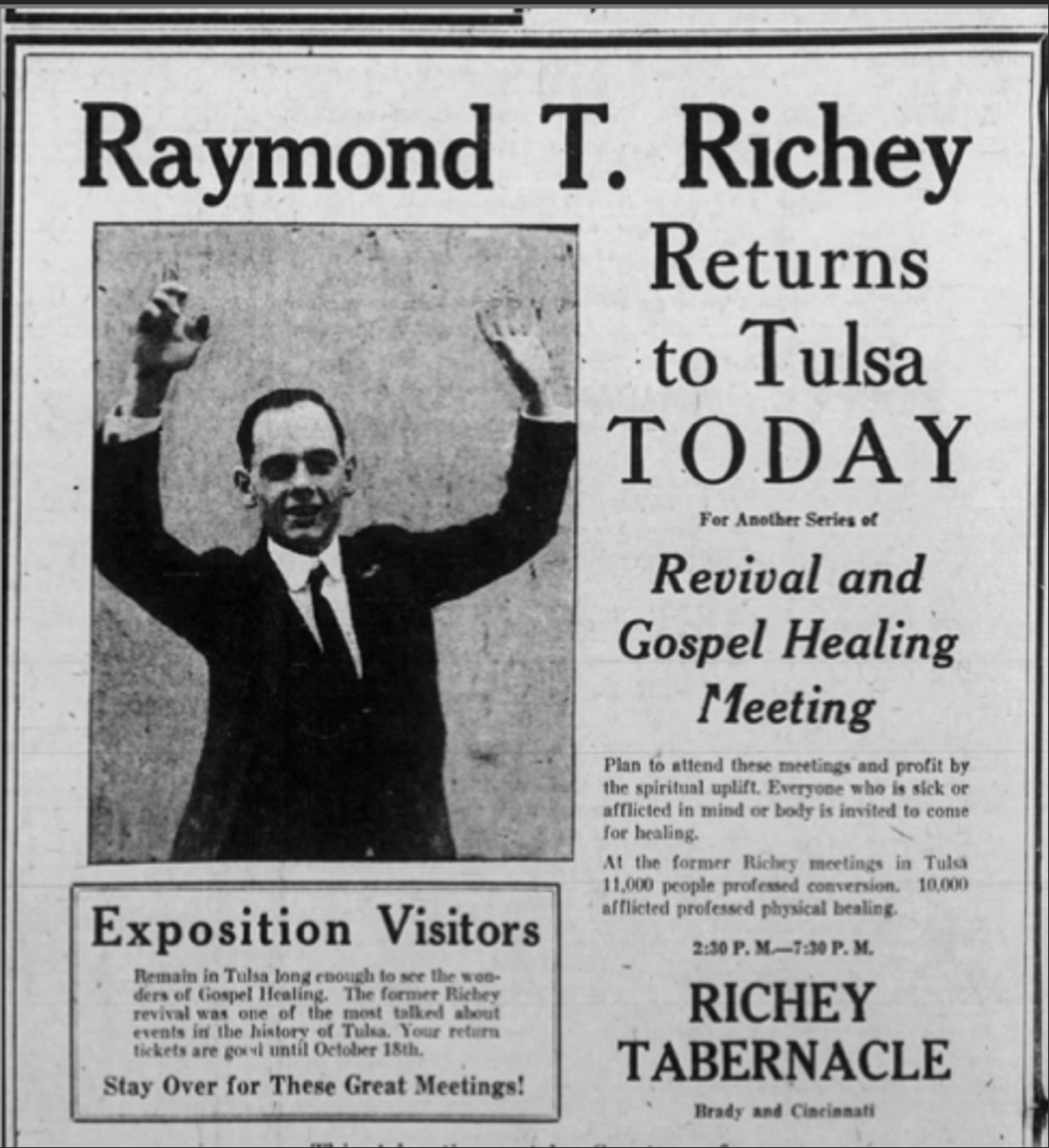
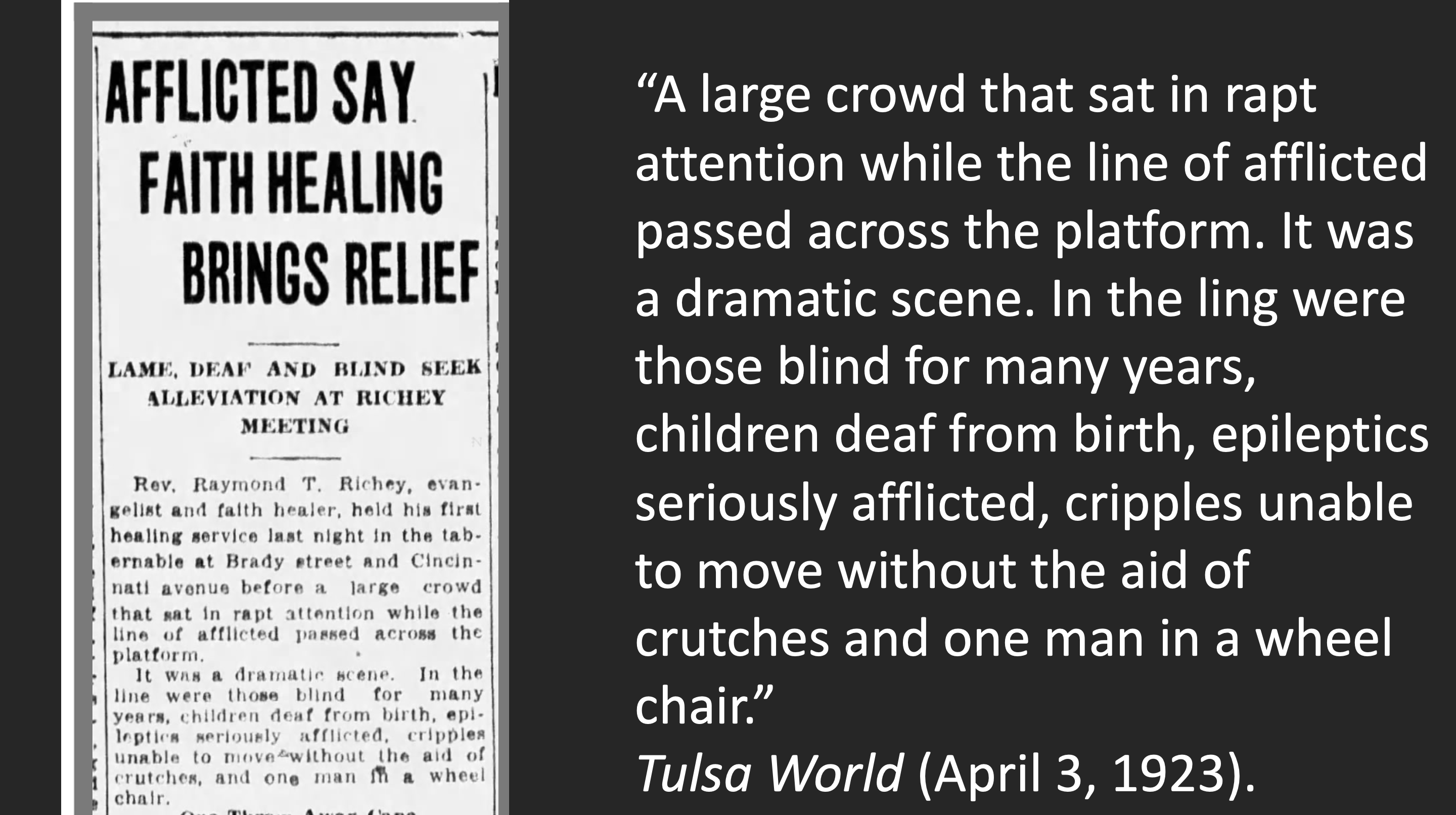
The land was donated by Charles Page, and he, along with several businessmen, financed a $4,000 tabernacle to hold over 1,000 people at the northwest corner of Brady and Detroit. Richey’s revival was a huge success. The Pentecostal Evangel reported, “This is said by Mr. Richey and party to be the greatest revival ever held. The number of professed conversions is 10,400. 9,000 healing cards were issued.”[2]
A Presbyterian minister named William Freeman Garvin, who helped sponsor the meeting, was convinced that healing was for today. Garvin grew up in Ohio and attended college at Moody Bible Institute and Lane Theological Seminary. He eventually moved to Tulsa to pastor a Presbyterian mission church, where he heard about the Pentecostal baptism in the Spirit, an experience he believed he had already received when he was called into ministry.[1]
His growing interest in Pentecostal teachings, like healing, led him to support the Tulsa Ministerial Alliance sponsorship of the Richey Revival. Convinced that healing was for today, Garvin taught it at his Presbyterian church, but it was not well-received. Garvin became more involved in the revival services.
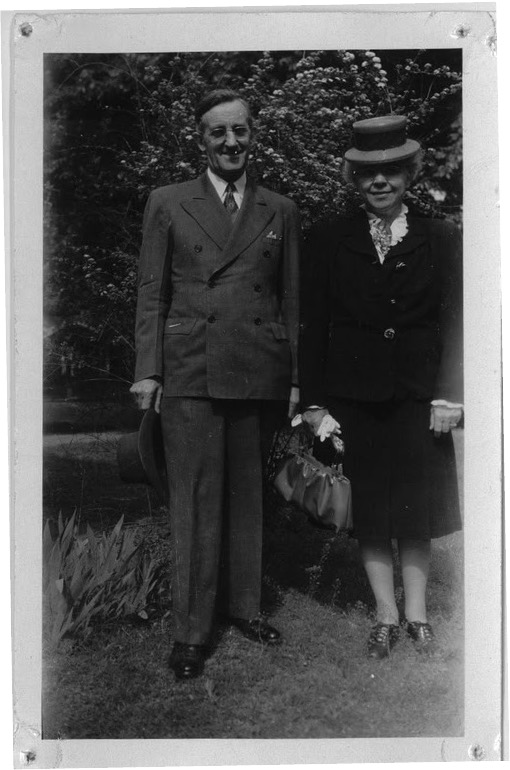
Charles Page took note of Garvin and asked him to pray for his healing from diabetes. After Richey’s services closed, Page allowed Garvin to continue holding the services until Page could find a buyer for the property. Page admired that Garvin would take a stand for his new Pentecostal beliefs, even at the cost of losing his congregation. Page’s biographer notes, “Charles Page admired a man who let the Spirit lead him, whether it was the popular thing to do or not.”[2]
Garvin continued to hold services in the large tabernacle but invited many other evangelistic parties to come and minister. One such evangelist was famed “child evenagelist,” Uldine Utley, who ministered in Faith Tabernacle from October 19 to November 9, 1924.[3]
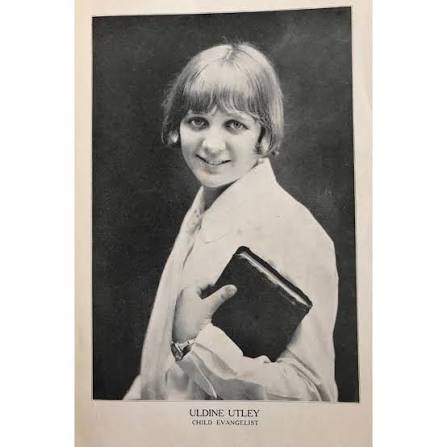
Utley preached the baptism in the Spirit and convinced Garvin and his wife to seek for this experience. A few days later, they both received the baptism in the Holy Spirit on November 12, 1924.[4] Several others in the small but committed congregation also received the baptism in the Spirit, including Etta Henry, wife of Fred Henry the famous blind pianist.[5]
In early 1925, Charles Page told Garvin that God had spoken to him about a more permanent building a church for Garvin’s Faith Tabernacle congregation. Page told Garvin,
“The Lord didn’t call me to preach and He didn’t call you to make money. But if I make the money, and you do the preaching, and I furnish the money for a church for you to preach in, that will make me a kind of preacher, won’t it? You surely would not deny me the pleasure of being of a preacher in this manner?[6]“
Page described to Garvin the details of the building that God showed him. It turns out that what he described was identical to what had also been given to Garvin in a dream. Page purchased a lot at 13th and Trenton for the new church. In August 1925, they broke ground on the new brick church.
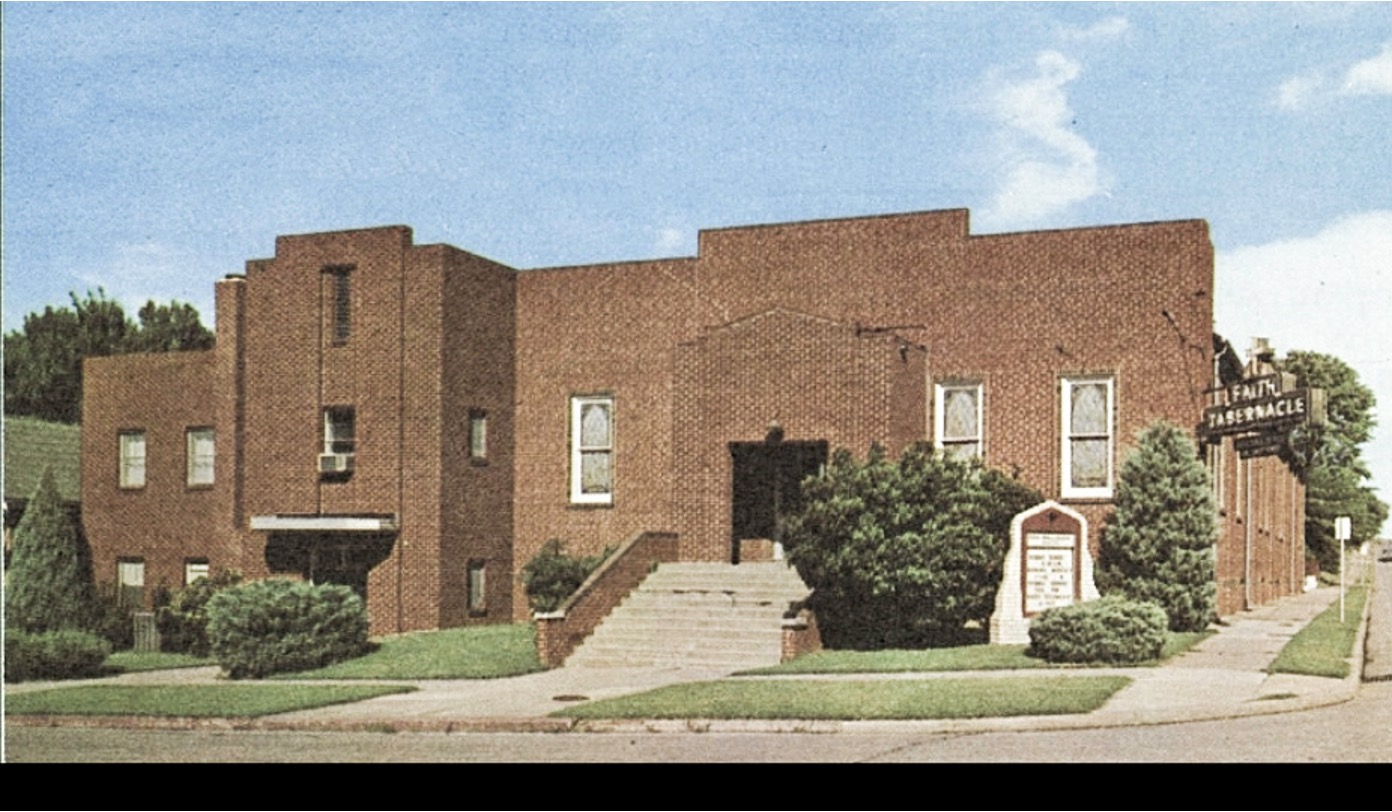
Faith Tabernacle c. 1940s (Faith Church)
The first service at Faith Tabernacle’s new building December 11, 1925 with more than 100 people in attendance. Since Richey’s revival was largely responsible for many of the members of the church, Garvin asked Richey to perform the dedication ceremony in June 1926.
The church was officially incorporated on July 17, 1926. As the church continued to grow, space was needed for Sunday school and other church needs. In October 1928, the church purchased the frame building from the old Boston Avenue AME Church at 5th and Boston and moved it onto the property.[7]
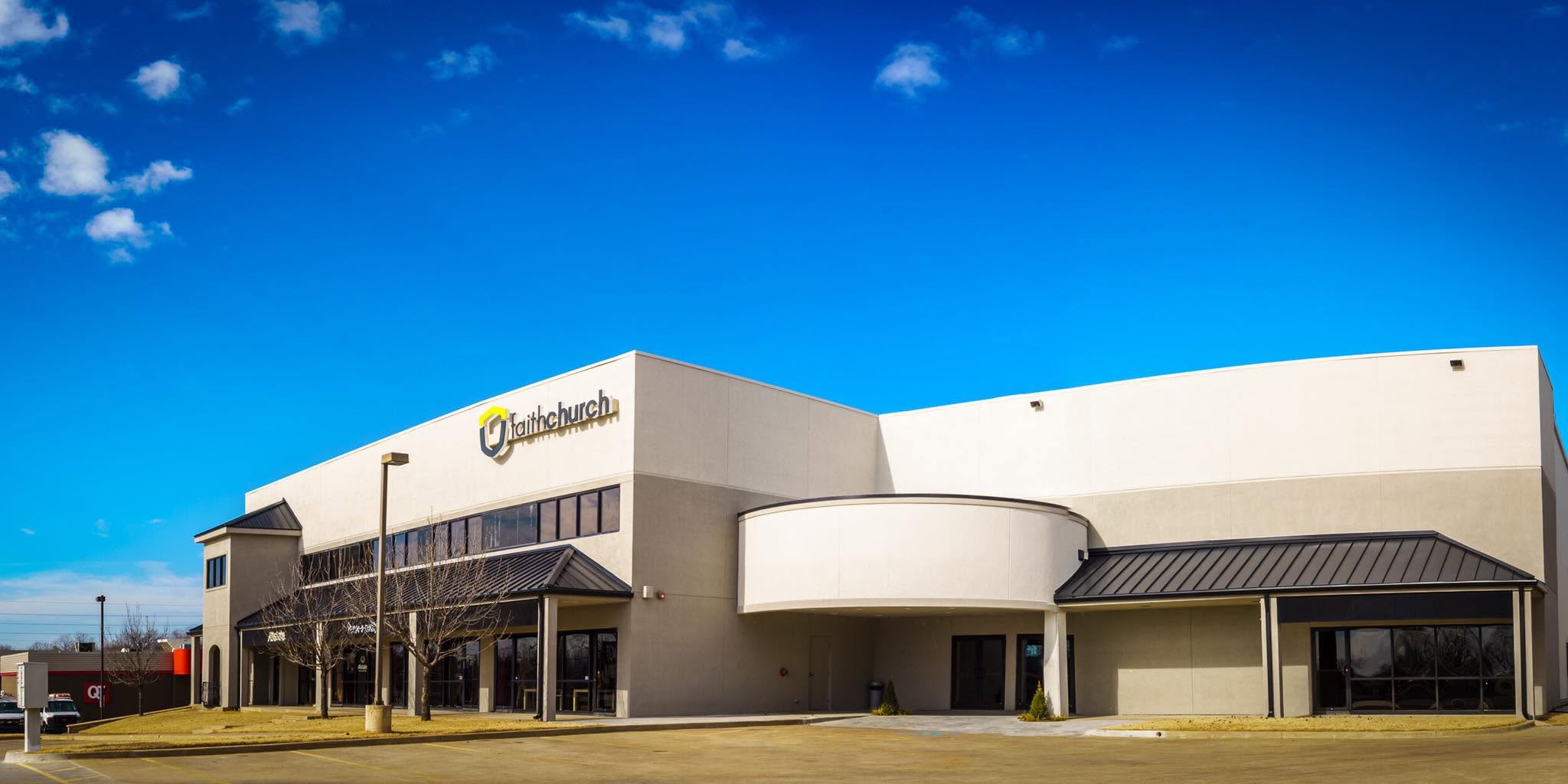
In 1940, the frame building was replaced with a more permanent building. In 1970 the church moved into a new building at 21st and Memorial, under Pastor Harry Myers.
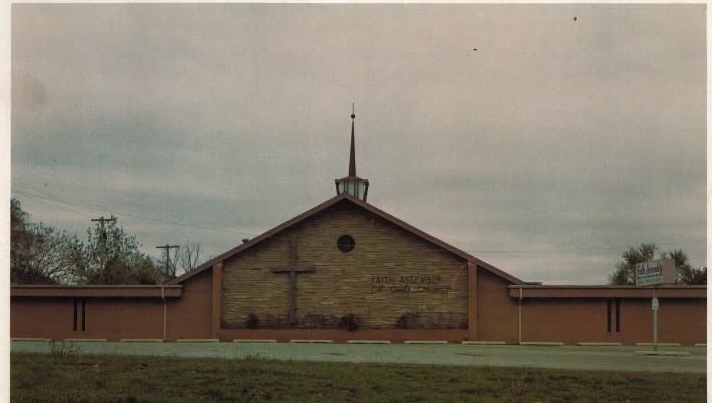
Although Garvin was ordained with the Assemblies of God, Faith Tabernacle remained an independent church until 1940. Some of the other pastors included Tommy Hollingsworth, L. J. Underwood, Don Mallough, Harry Myers, Grady Adcock, Bill T. Storie, Markus Alexander, and Ernest Strong.
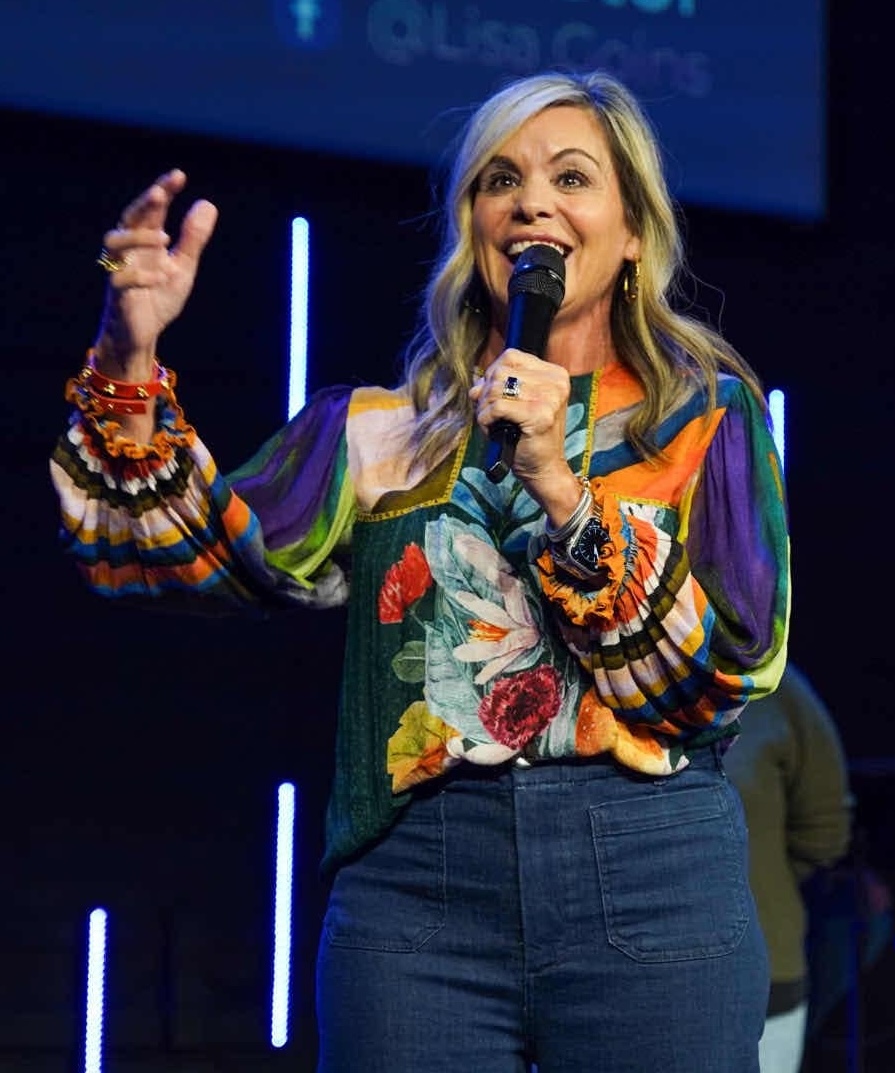
Today, the church is pastored by Dr. Kelly and Lisa Goins, who became pastors in August 2003. In 2016, a new location was chosen at 81st and Memorial, and it was renamed Faith Church.
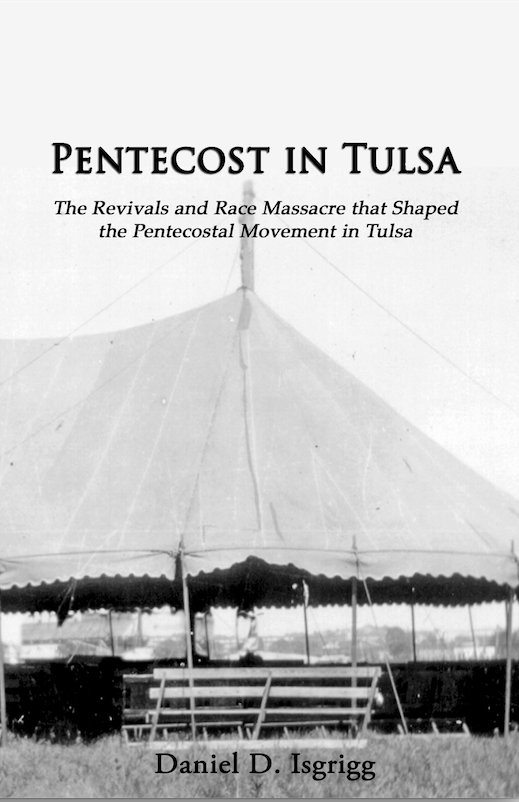
Read more about Tulsa’s Pentecostal History in my book Pentecost in Tulsa, available here
[1] “Start Next Week on Tabernacle for the Richeys,” Tulsa Tribune, March 15, 1923, 3.
[2] “Triumphs in Tulsa,” Pentecostal Evangel, August 4, 1923, 8.
[2] Opal B. Clark, A Fool’s Enterprise: The Life of Charles Page (Sand Springs: Dexter Publishing, 1992)256.
[3] Thomas A. Robinson, Preacher Girl: The Uldine Utley and the Industry of Revival (Waco, TX: Baylor University Press, 2016), 122-25. Uldine Utley was a famous girl evangelist born in Durant, Oklahoma in 1912. Her parents, Azle and Hattie Utley, had settled in Lawton in the Oklahoma Territory during the land run near Lawton. It was there that the Utley’s became friends with the famous Native American leader, Geronimo. During the 1920s, from age eleven until twenty-four years old, Utley became a famous Pentecostal Flapper Era “girl evangelist” in the United States.
[4] Constitution and Bylaws of Faith Tabernacle of the Assemblies of God, 6.
[5] Gohr, “Walking by Faith,” 10-13.
[6] “History of Faith Church,” Tulsa, Oklahoma, 2020.
[7] Adapted from W. F. Garvin’s history of the Church in the Constitution and Bylaws of Faith Tabernacle of the Assemblies of God, 7-10.

